

Top 6 Residential Proxy Providers in 2026: Speed, Reliability, and Anonymity
Residential proxies: premium quality or expensive markup? We tested 6 top providers head-to-head. Find out which one actually delivers speed, stability, and real value for your money in 2026.

What is a residential proxy?
Residential proxies are proxy servers that use real IP addresses of home devices provided by Internet Service Providers (ISPs), rather than data centers (server proxies).
Simply put, these are the IP addresses of ordinary internet users assigned to them by their providers. For example, the ISP AT&T assigns IP addresses to each user of its services, and these very same IP addresses can be used in residential proxy pools purchased by those who need them.
Bypassing AI Anti-Fraud: Why "Natural" Traffic Matters
This approach ensures the most "natural" traffic behavior (you are seen as a regular internet user, which naturally increases the trust level).
Modern anti-fraud systems, especially those based on AI, have learned to very quickly recognize cheap free proxies, server proxies, or the use of VPNs. And naturally, if your script uses “unreliable” proxies for serious tasks (for example, scraping search engine results), you will have to spend more (CAPTCHA solving, new IP addresses), and it is not yet clear what will be more profitable-cheap proxies or higher-quality residential ones.
The 2026 Market Shift: Price vs. Quality
In 2026, the demand for residential proxies continues to grow exponentially, driven by the need to bypass advanced anti-fraud services, emulate real users, and work with well-protected data.
However, price has always been the limiting factor. Residential proxies have historically been more expensive than server proxies, but everything is changing. Players are appearing who are dumping prices and offering excellent quality at an affordable rate. And this is a reason to check how they differ from the more expensive ones that competitors with big names continue to sell. Is this a marketing ploy, or has the market really swung towards inexpensive and high-quality solutions?
The Floppydata Challenger: Changing the Pricing Rules
As an example of such a player, we can cite the residential proxy service Floppydata. A relatively new player in this market that has changed the rules of pricing. The service offers high-quality residential proxies at a fixed price of $2 per 1 GB (without hidden fees and mandatory subscriptions). And compared to the giants of the market, this is a strong competitive advantage; why buy proxies for $5 if there is an opportunity to buy them for $1?
However, so far these are just statements and declarations; let’s check how the proxies from different providers behave in real tests.
How and what we checked to determine the best residential proxies provider
For an objective comparison, we conducted a series of automated tests across the following metrics:
- Reputation scoring: We ran the IP addresses of all participants through risk assessment services like AbuseIPDB. A unified risk level is calculated for each address based on the presence of the IP in blacklists, history of complaints, and whether the IP belongs to data centers.
- Network performance: We measured speed by downloading a reference file, recording three key parameters: RTT (Round Trip Time), TTFB (Time To First Byte), and average download speed (Download Mbps).
- Anonymity and security: Each proxy was checked for DNS leaks and correct request handling (SOCKS5 vs SOCKS5h).
- Connection stability: We conducted a stress test for availability, including a series of 50 consecutive requests to the target node. This allowed us to record the real percentage of successful connections and the average response time under load.
RANKING: Top 6 Residential Proxy Providers in 2026
In this review, we will compare the following industry representatives:
- Floppydata
- Bright Data
- Decodo
- SOAX
- IPRoyal.
Floppydata - Best Residential Proxies at a Low-Cost Price
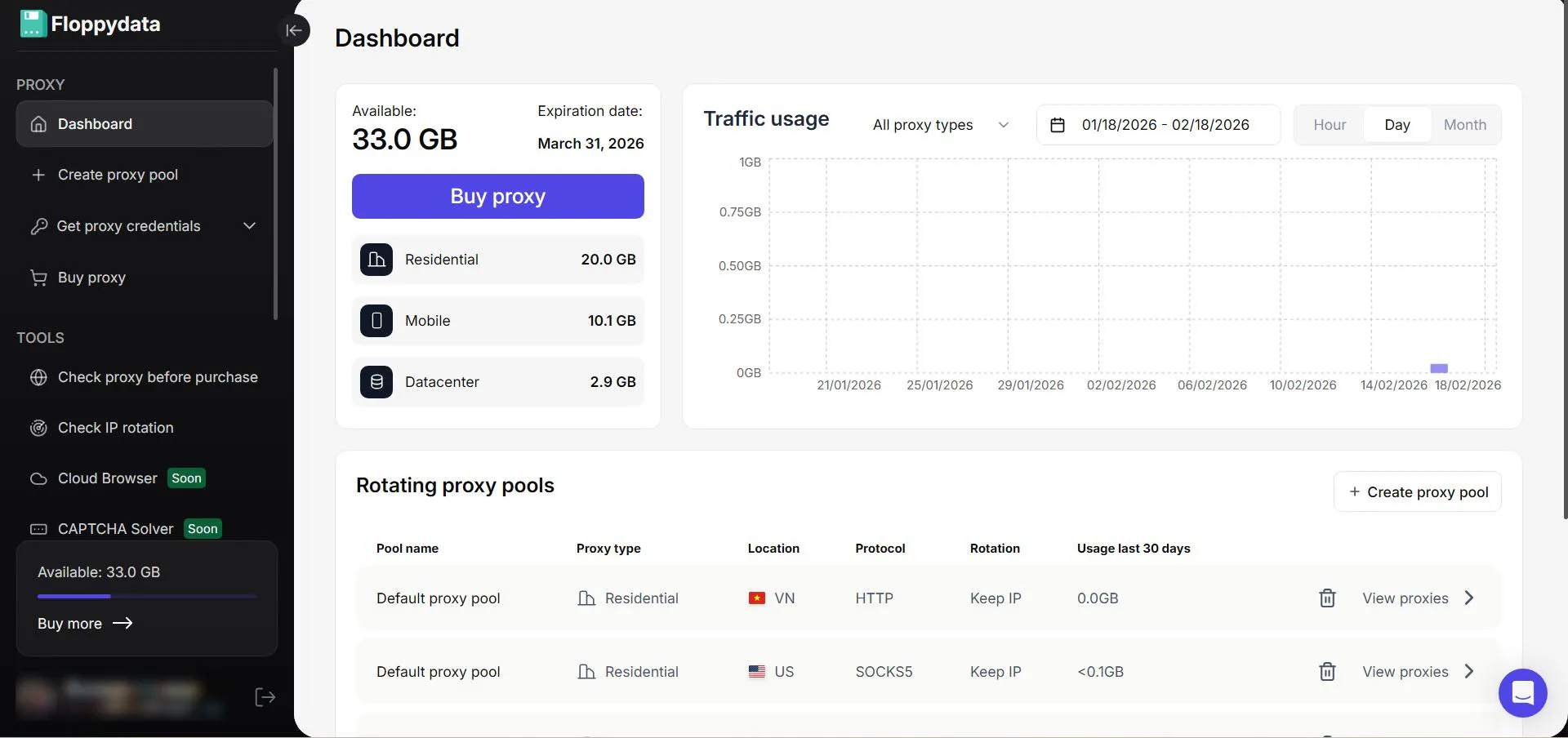
It is no coincidence that we placed Floppydata at the very top of the list, as based on the aggregate data, this provider is the absolute leader. One could even say they provide premium quality at a low-cost price. Now to the details.
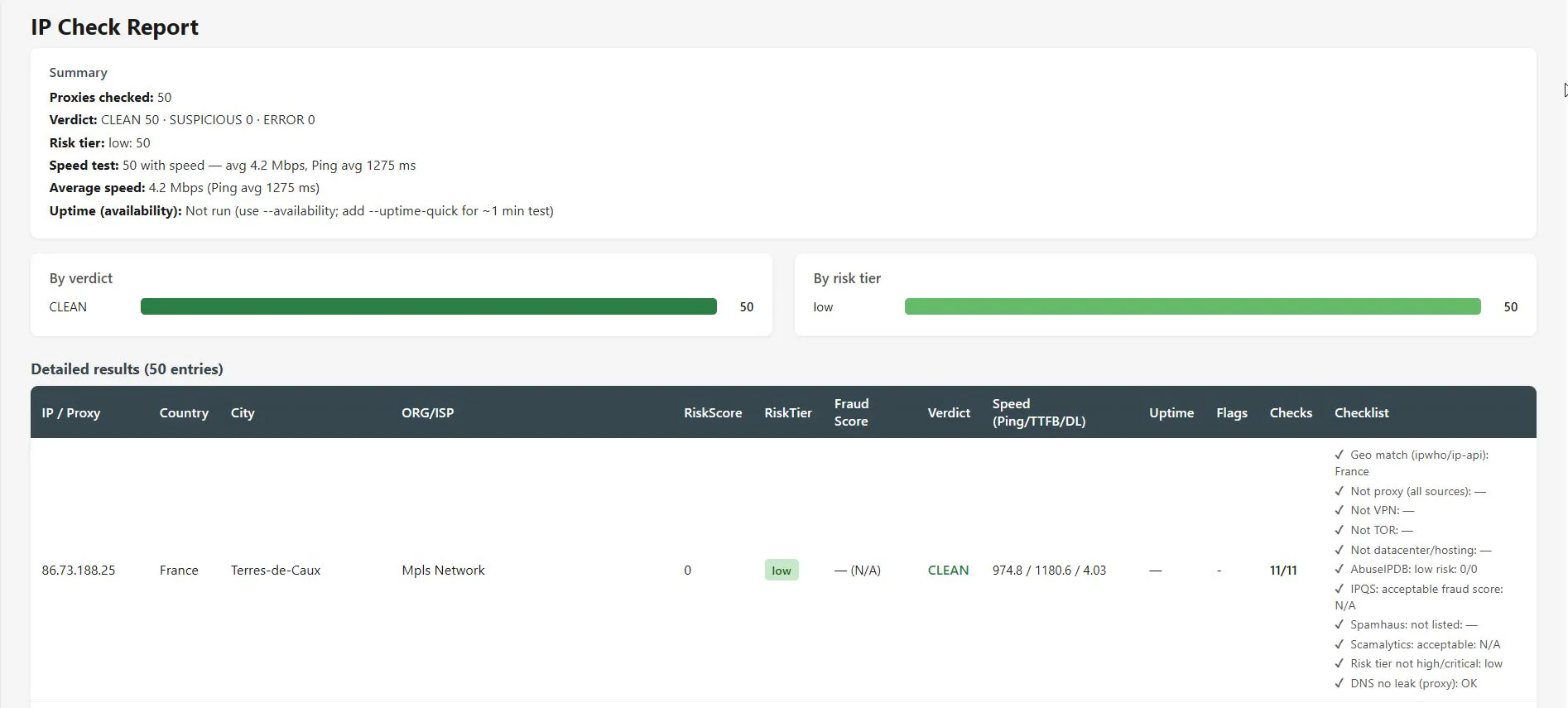
Test results showed excellent reliability - 99% successful connections within the control sample (and our sample was 50 addresses). But during the script configuration process, many more addresses passed through it, and in the situation with Floppydata, the reliability sample actually totaled 250 addresses, and in each case, we received from 98% to 99% success, which is impressive.
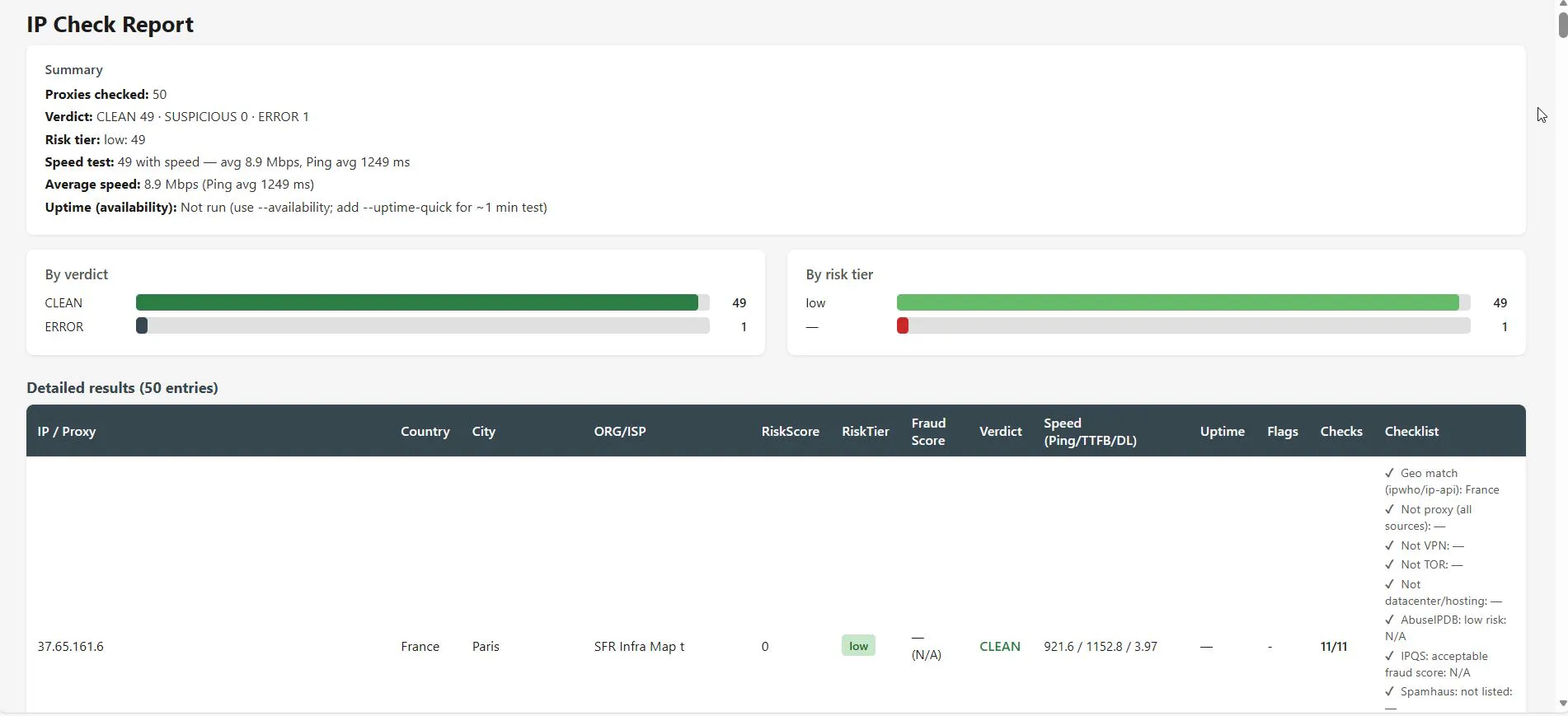
The average response time was about 1.0-1.3 s, which is considered a standard indicator for a high-quality Low Latency Proxy with complex routing.. The main advantage is the absolute stability of the data flow, which minimizes the need for repeated requests. And if you select the correct GEO, you can achieve even better speed indicators.
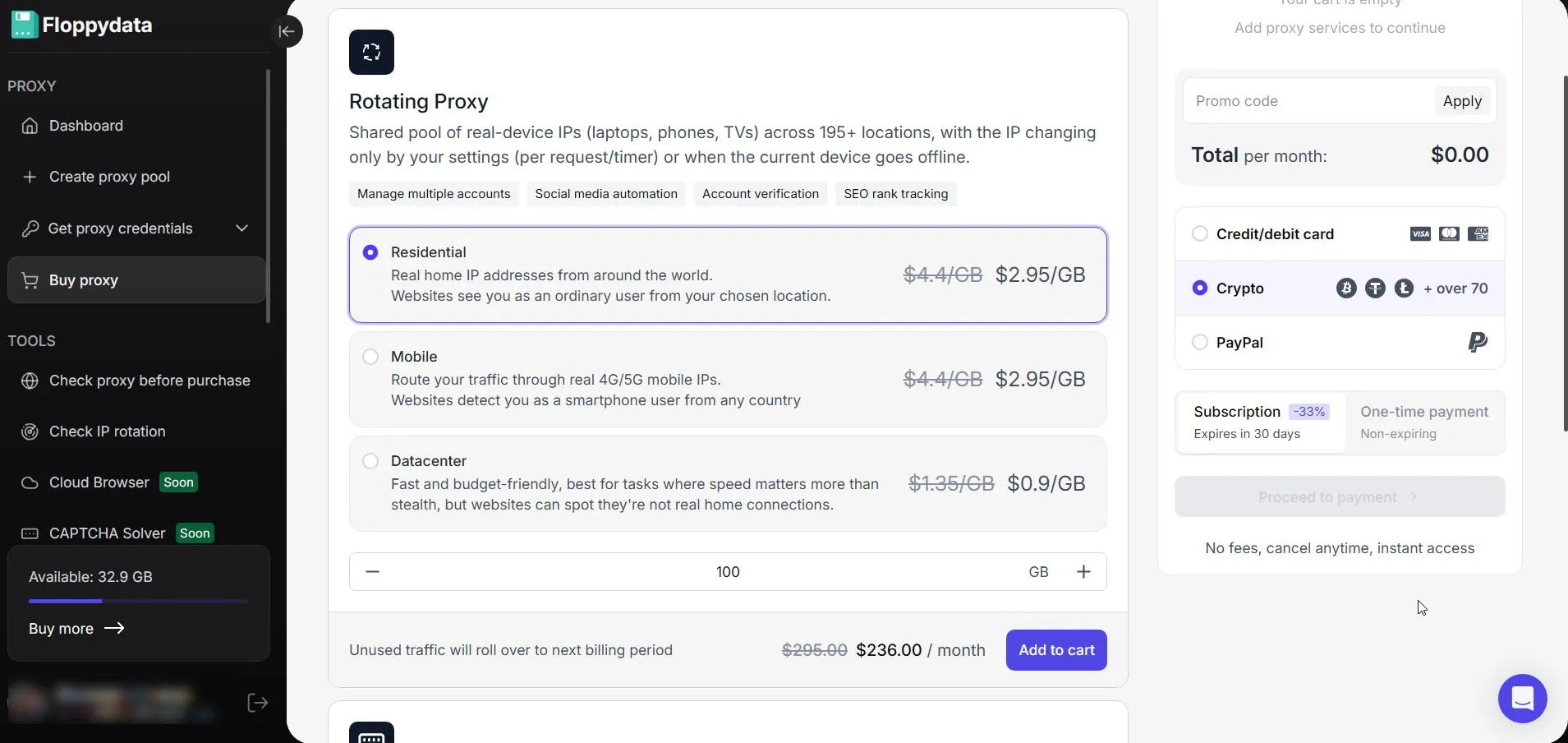
Price: fixed price of $2 per 1 GB of traffic (no hidden commissions and subscriptions) provided that traffic is purchased from 100 GB.
Where to buy residential proxies is not the problem, but how to manage them?
The personal dashboard is an important component of interaction with the provider, and everything is excellent here. Everything is in its place, nothing superfluous, and you can figure it out in a couple of minutes.
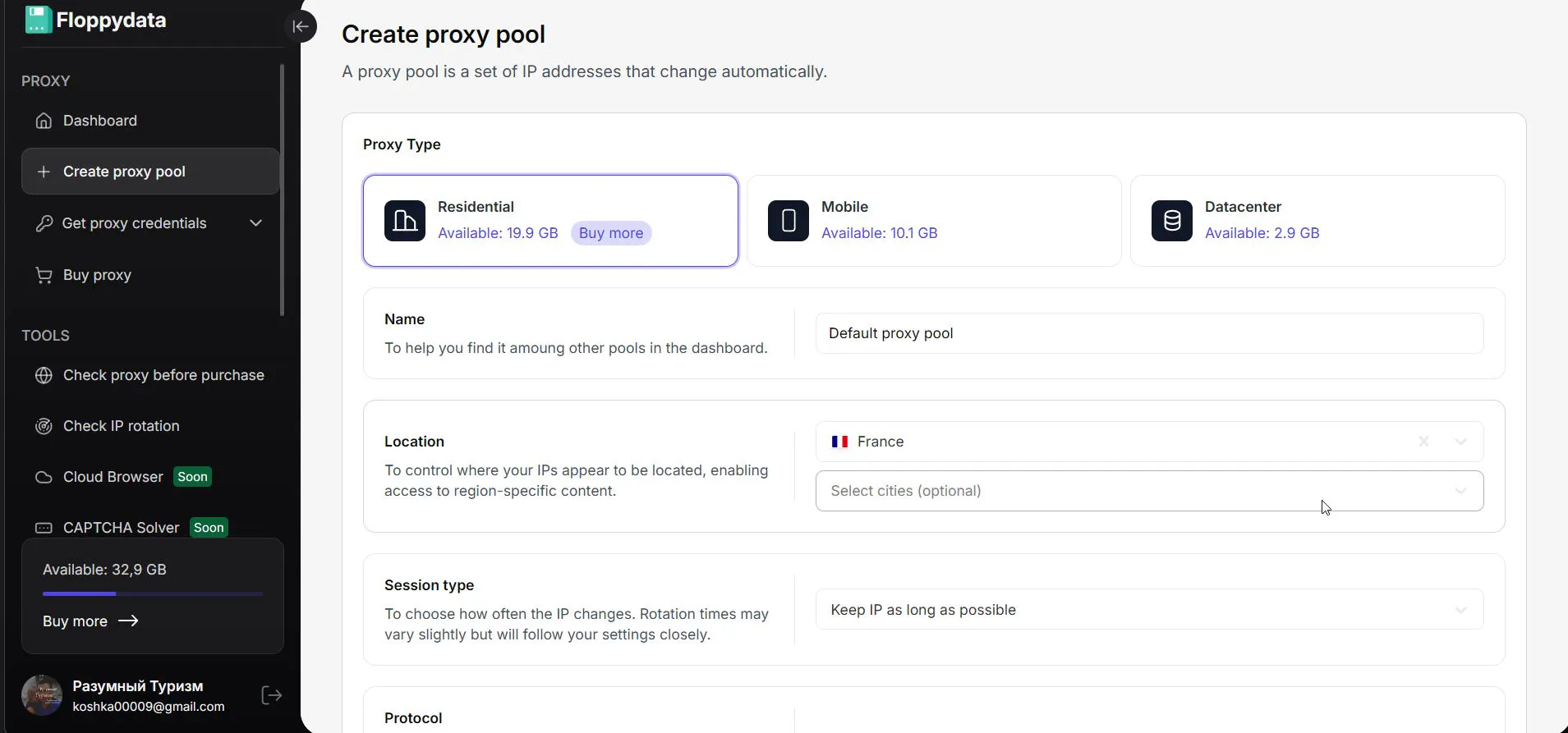
Intuitive web interface. You can generate a proxy pool in literally two clicks. If fine-tuning isn't needed and you need to start working quickly, choose the section “Create proxy pool”, and all settings are already pre-installed there - residential proxies are selected, the default country is set to “France”, 10 proxy units. It remains simply to click on the blue button and generate a pool of residential proxies in one click.
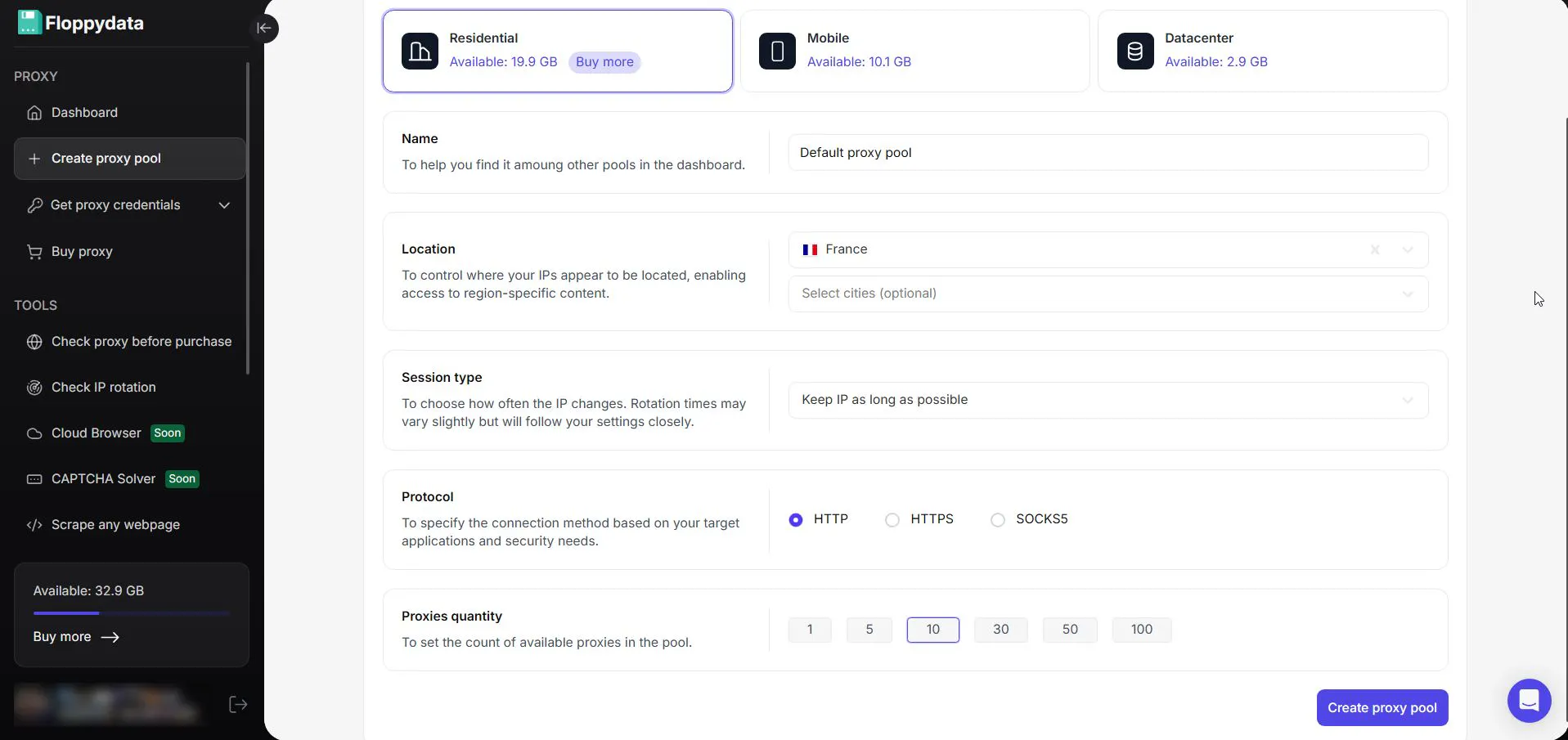
For fine-tuning, there are also no particularly complex settings. You can select the proxy type, connection country, session lifetime, and protocol.
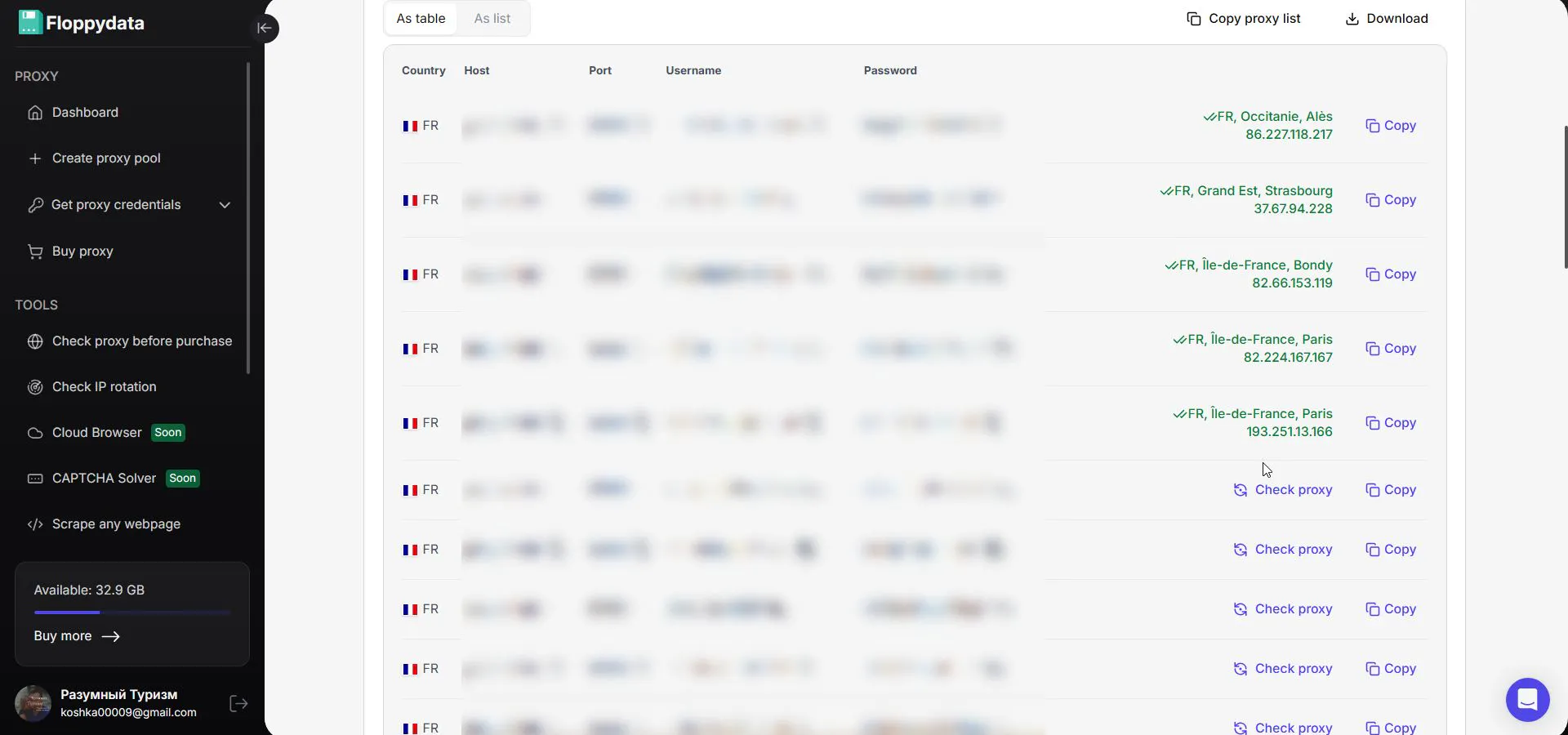
The resulting pool includes hundreds of IP addresses (depending on the country, the figure may change; somewhere there will be fewer addresses). It is convenient that you can immediately test the obtained proxies in one click; not everyone can boast of this, as with some providers the check happens on the script side and the replacement process drags on in time.
Integrations
Residential proxies buy to use them in other services - this is logical. But native integration is not provided everywhere. Floppydata has it; for example, they integrate perfectly with popular anti-detect browsers. In the panel, you can copy a string in the format host:port:username:password for instant pasting into GoLogin, AdsPower.
Overall, this is the best solution for scaling in 2026: Floppydata's balance of price, quality, and reliability is top-notch.
Bright Data - The Corporate Giant
Bright Data, like any giant, has a heap of hassles for users. You can't just simply go and create an account on this service and start using it. Any step they deem suspicious leads to an immediate freezing of the account, and then the account is sent for manual verification (this procedure takes up to 2 days).
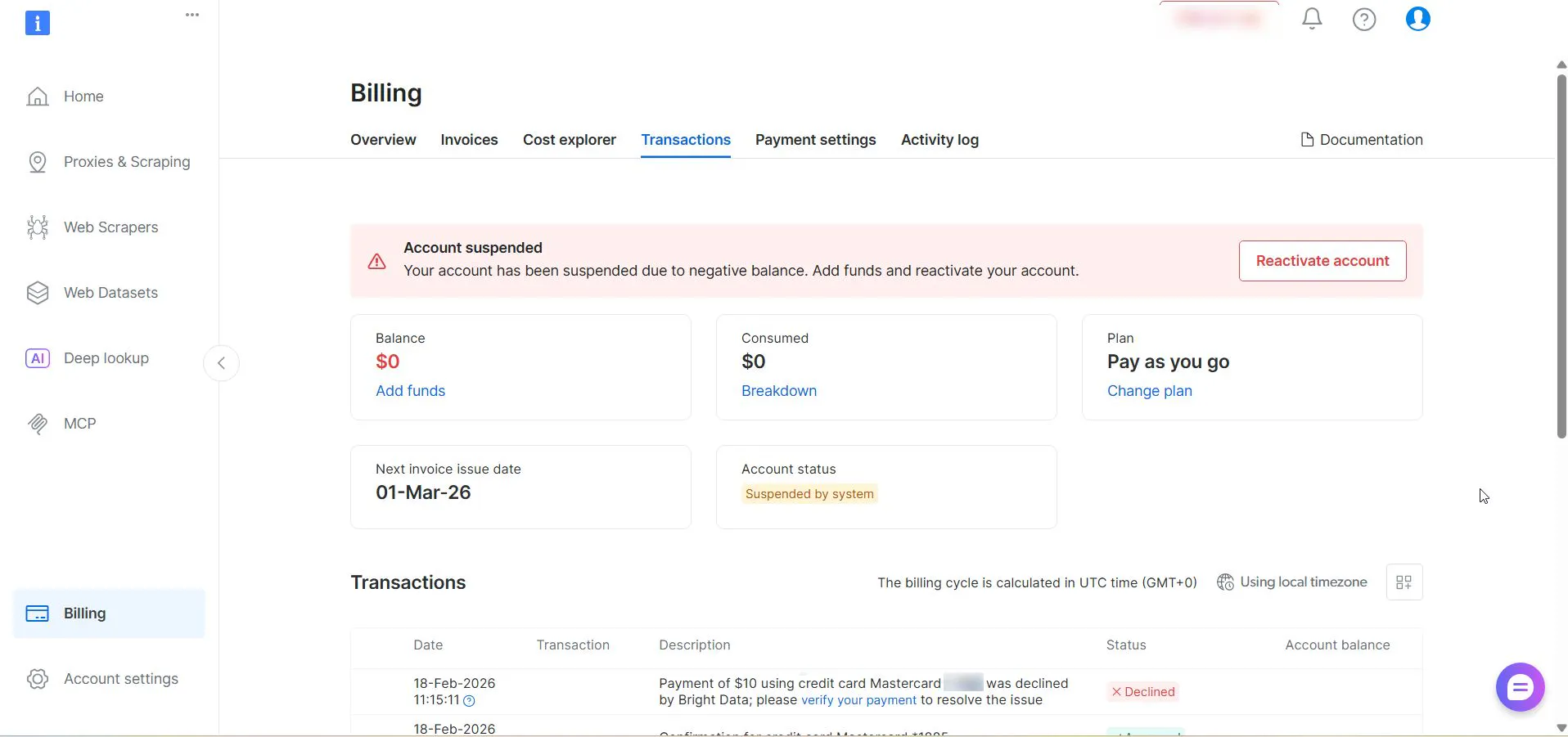
For verification, they require you to provide a photo of your document and a photo of the card with which you attempted to pay the invoice.
The main consumer of services providing proxies are developers of parsers, automation scripts, etc., and as a rule, this category of users is not thrilled with KYC verification and similar checks.
What is claimed
The negatives are clear, but there are positive aspects too. Someone uses this service, after all; otherwise, it wouldn't have become a giant and wouldn't have started inventing stupid rules that it trips over itself. According to the service's statement, they have the largest pool in the world - over 150 million+ residential IPs in 195 countries.
But objectively, the figure is inflated, and for example, in Asia, in some countries, their IP addresses repeat regularly. This is not their flaw; it historically happened that way and is the case for everyone, but Bright Data for some reason highlighted this as their USP.
Test results of residential proxies we managed to buy from Bright Data
Bright Data redirects requests through its global network of super proxies, which ideally ensures connection stability but increases latency. This is visible in the tests; the latency was over 3 seconds (Floppydata had 1 sec).
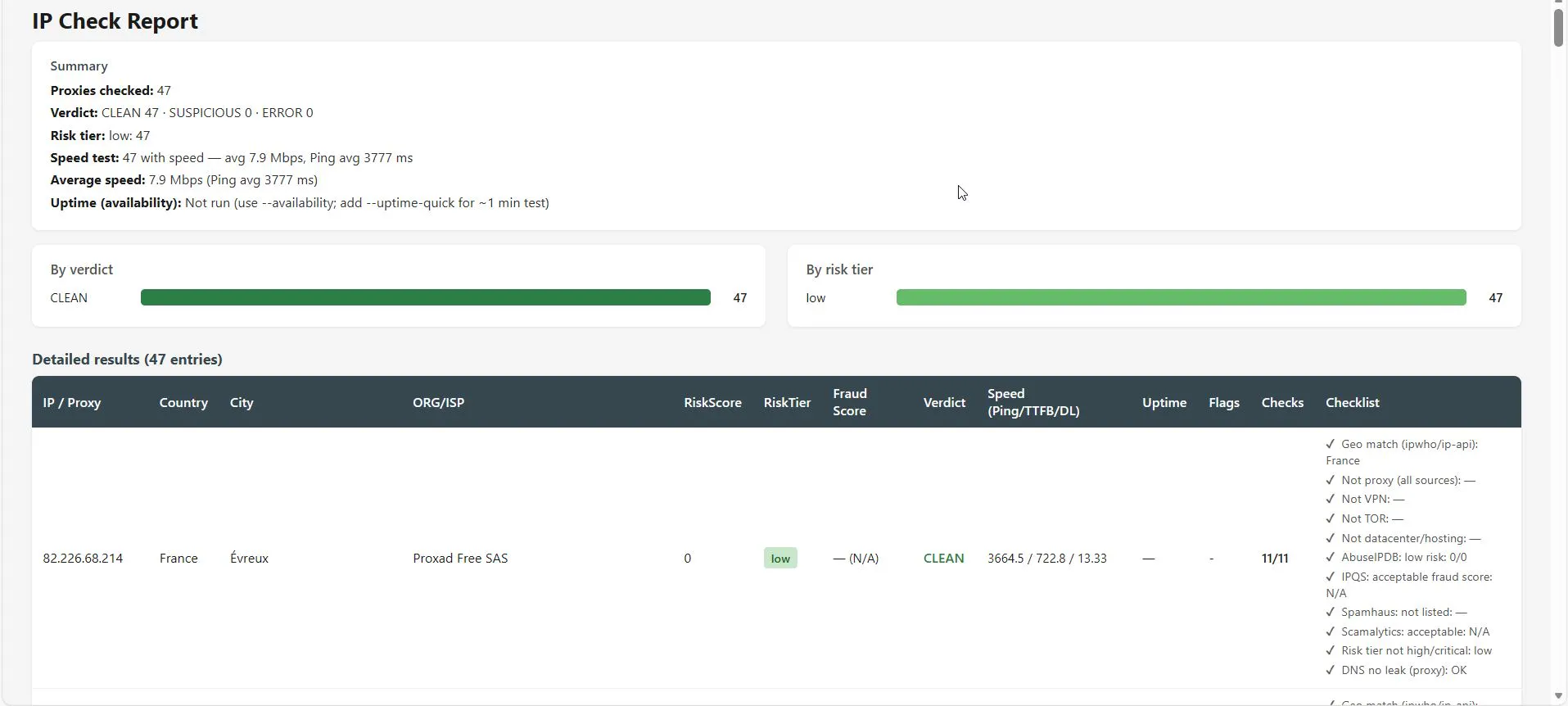
Otherwise, everything is about the same - the IP addresses are all in the green zone - no complaints or spam flags were noted on them.
Regarding reliability, everything is also good, 100% successful connections, but the speed under load sagged even more.
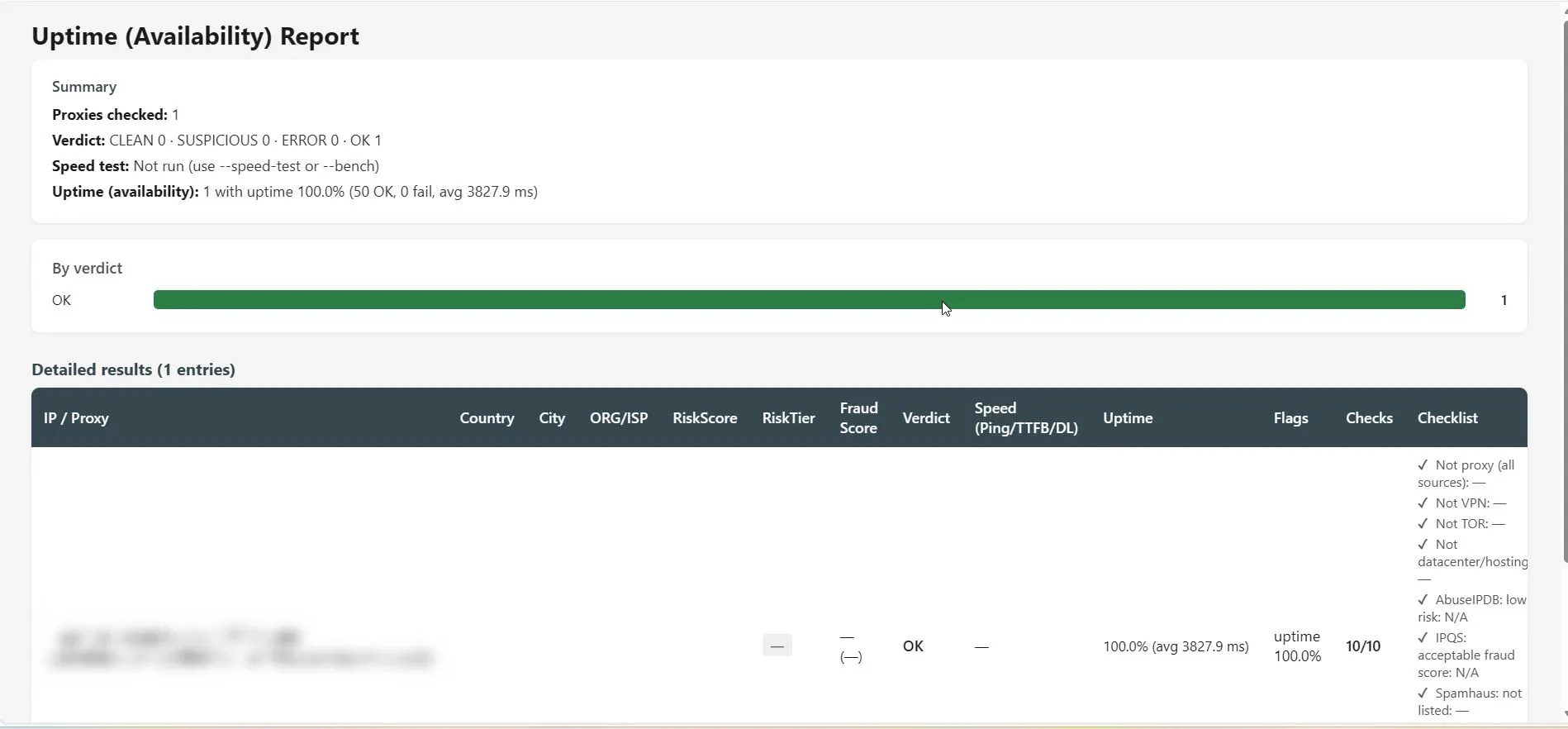
And if we compare the two proxies against each other, everything is obvious - even at the price check stage, let alone a deeper comparison.
Prices for buying residential proxies
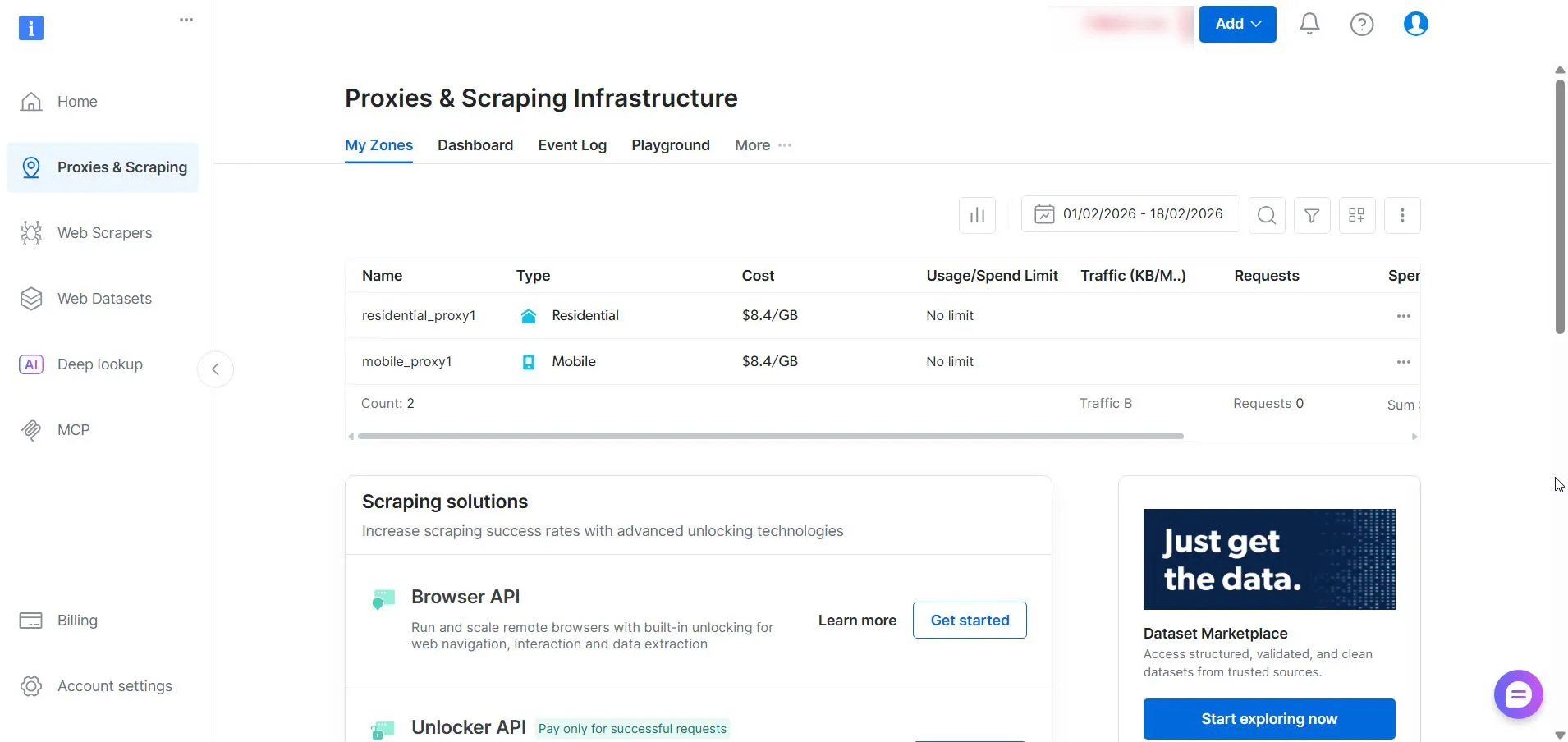
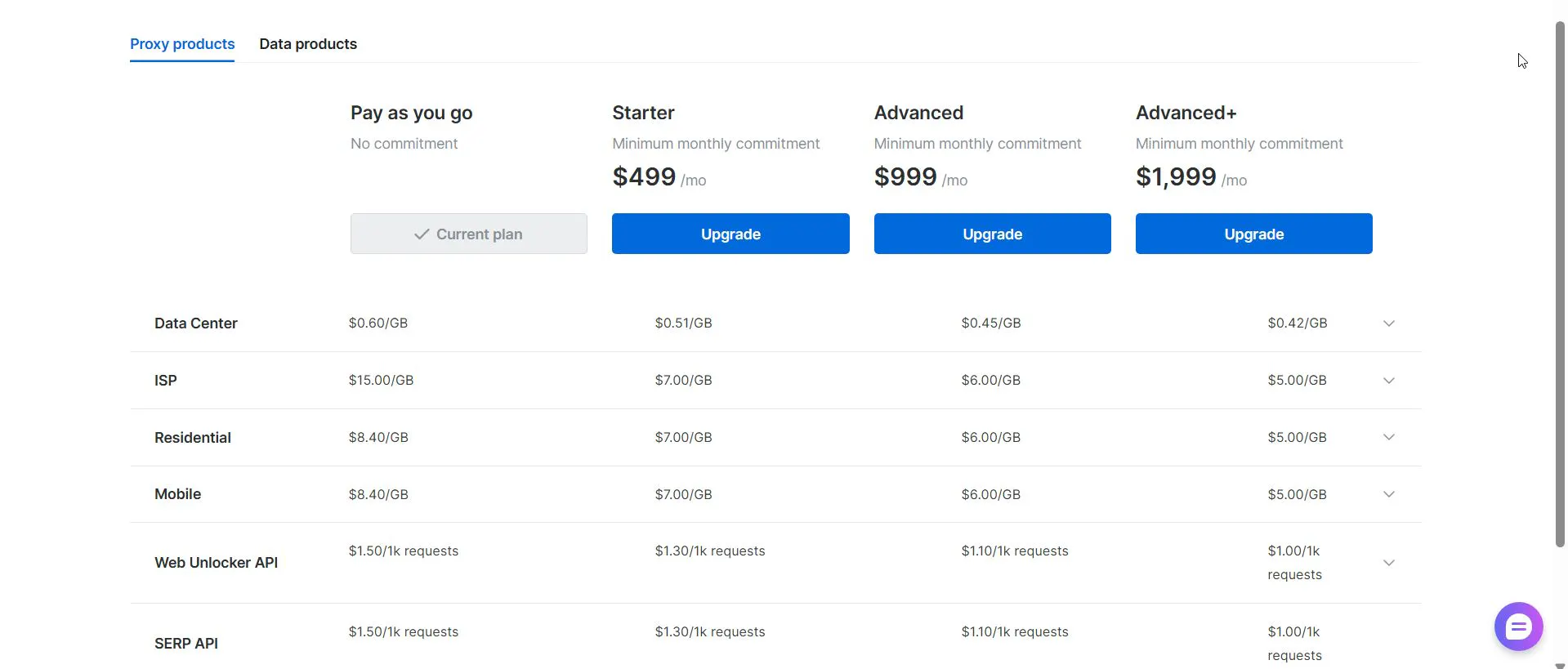
In contrast to Floppydata, the cost of 1 GB of proxies at Bright Data is shocking - $8.4 for 1GB; this is not just excessive, this is a bit too much even for excessive. Even Adidas or Nike don't mark up the price for the brand that much.
It is possible to get it cheaper, but you need to buy [in bulk], the minimum cost of which is $499, but even in this case, the price is not much lower - $7 per 1GB.
Convenience for users
Control Panel: The main tool is the Luminati Proxy Manager (LPM). This is a powerful open-source proxy manager installed on Windows/Linux. Through LPM, you can finely set rotation rules, blacklists, traffic priorities, etc. However, LPM is not the simplest tool: it has a multitude of options and schemes that need to be studied carefully.
As for manual configuration - copying a proxy and pasting it into the necessary tool - here everything is not as unambiguous as one would like. The panel is slightly overloaded, you need to get used to it; there are no familiar settings like other proxy providers have. There is no possibility to bulk export many proxies at one time.
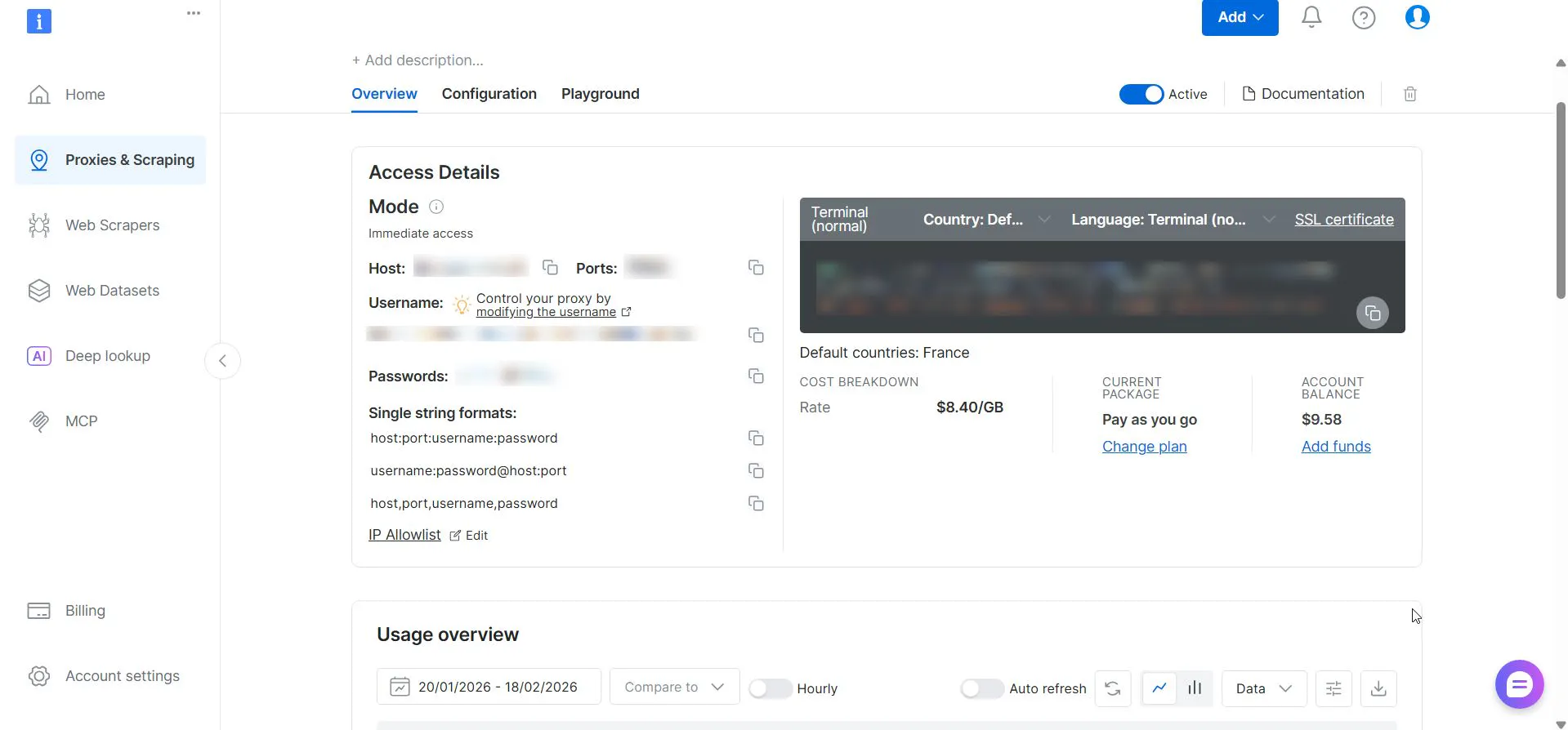
In the cabinet, everything is made for integration in different programming languages - ready-made code for insertion, but using it with an anti-detect browser is more difficult.
For lone wolves or small teams, the use of such a service will definitely be excessive.
Oxylabs - The Standard of Stability for Enterprise
If in the case of Bright Data, we managed to reach the payment moment, Oxylabs did not want to let us into the cabinet at the login and password entry stage and sent us for forced verification with a manager.
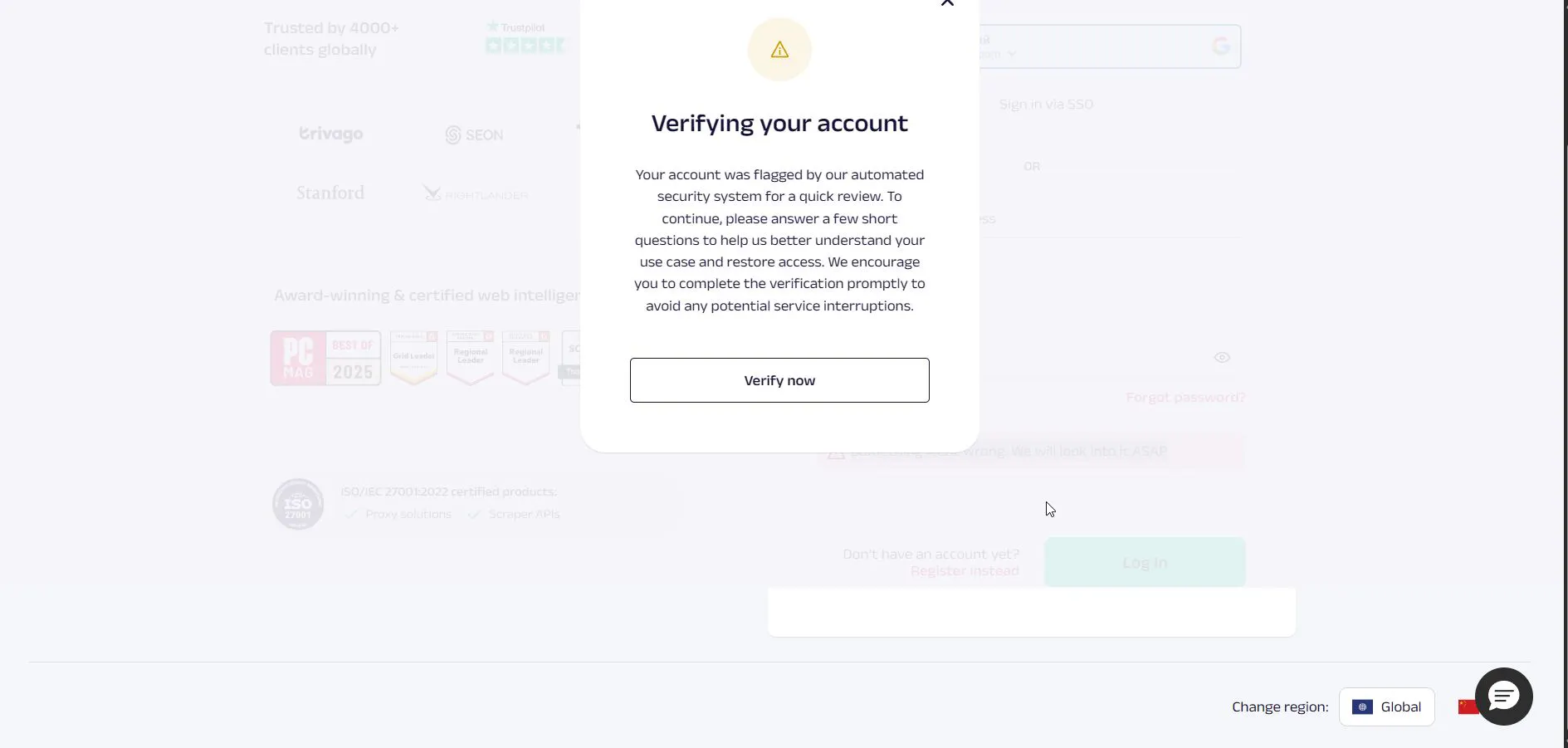
There is something about these giants. Repulsive.
Сhoose Oxylabs to buy residential proxies expensively.
The biggest minus that Oxylabs has - besides the inadequately strict security system we stumbled upon above - is their pricing policy. There is no free trial period, and the cheapest tariff they have costs $40.
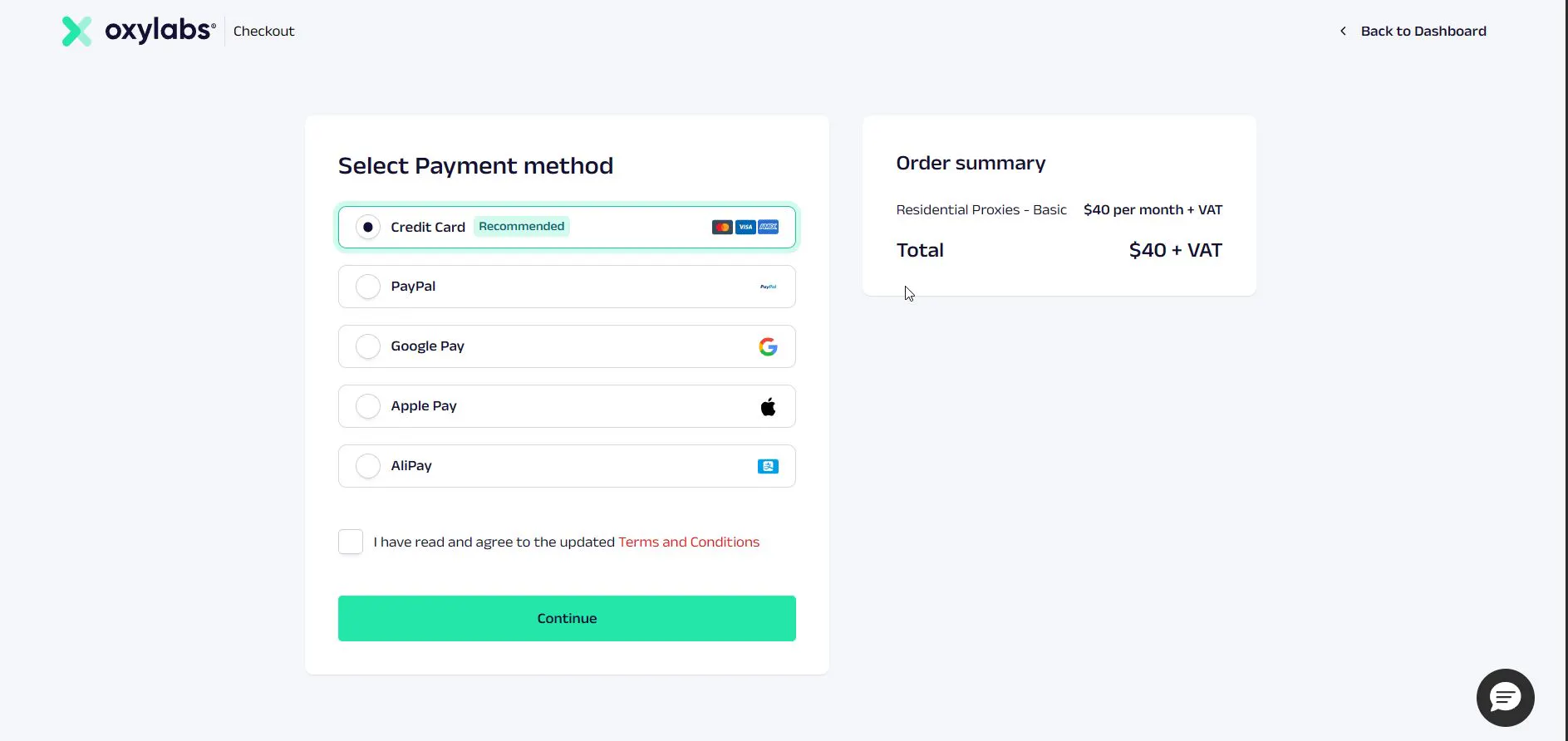
There was a feeling that paying $10 for the sake of a test is already excessive, and here it is 40 plus tax on the transaction. And what if the quality doesn't suit? Theoretically, you can request a refund, or you can simply use another service.
In general, residential proxies from Oxylabs cut off the audience with a low check at the start, focus on medium and large businesses, and gently push freelancers away with non-verbal signals.
General information about Oxylabs residential proxies
By tradition, Oxylabs also has one of the largest pools - 177 million+ IP addresses. The network is constructed in such a way that it is suitable for large-scale scraping - stability and performance are the priority. The success rate of residential proxy requests reaches 99.95%. This is what we want to check.
Testing the residential proxy pool
Oxylabs is SOCKS5 support service, alongside HTTP/HTTPS, which is important for complex scrapers and anti-detect applications. For heavy tasks (social media scraping, SEO monitoring, data mining), it is better to use specifically these proxies.
Based on the results of running 50 proxies, we received an average speed of 12 MB/sec and a latency of 3.8 sec, which is far from the best indicator for a service of the level they position themselves as.
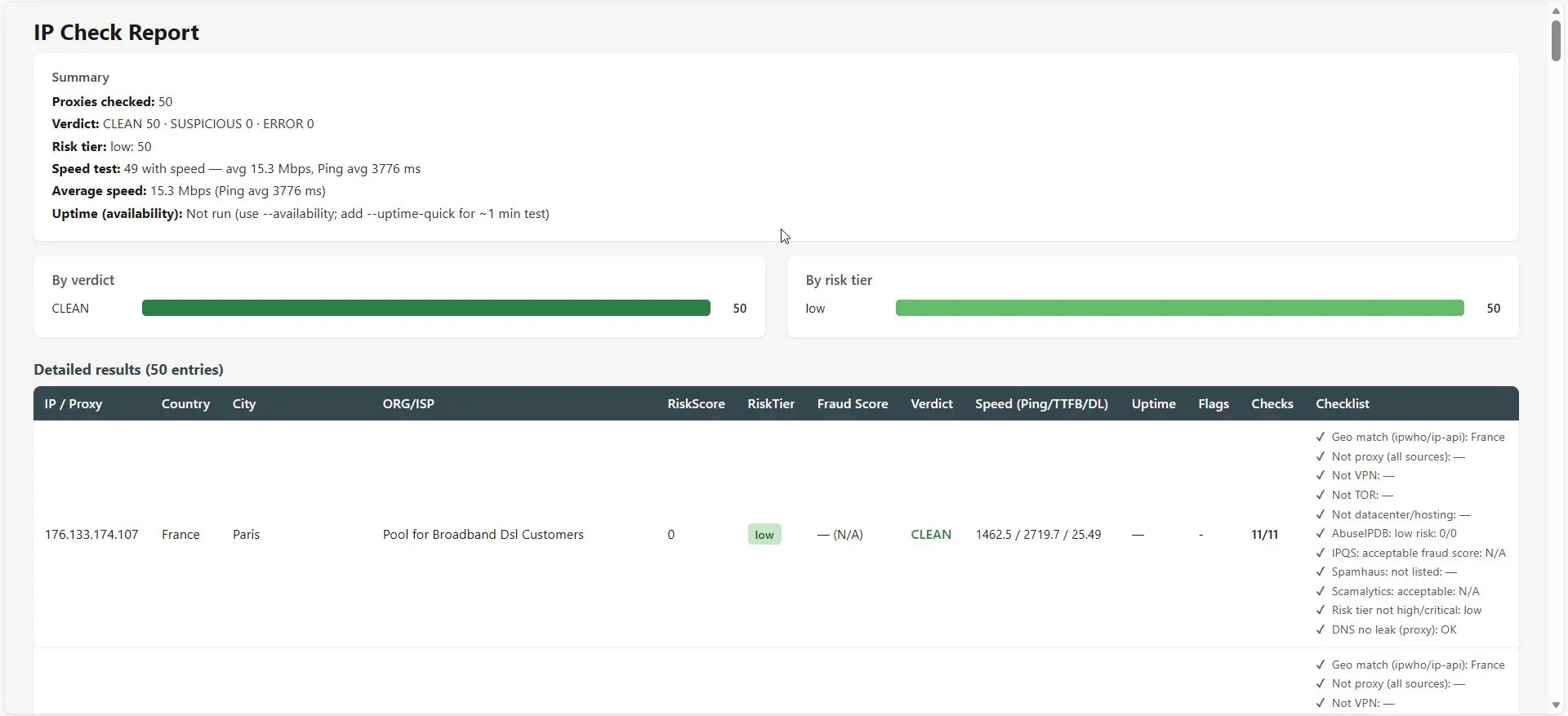
Well, regarding Uptime, everything is far from as rosy as one would like - the result is 80%, out of 50 requests, 10 returned with an error. This is a fat minus for a service of Oxylabs' level. Is there no feeling that they are trying to sell you a bottle of Jim Beam under the guise of Hennessy?
Admin Panel and API
Oxylabs has a sufficiently convenient API and management tools. Through the Dashboard, you can programmatically manage proxies, traffic limits, and sub-accounts. This allows for automatically scaling work to the needs of different teams.
And in general, the dashboard itself looks quite cozy and understandable. Difficulties with configuration do not arise. Login and password protection is implemented controversially, that is, when generating a proxy pool, you need to copy the entire pool and only after that replace the custom "YOUR-LOGIN" and "PASSWORD" with real values. A matter of taste - but not entirely convenient.
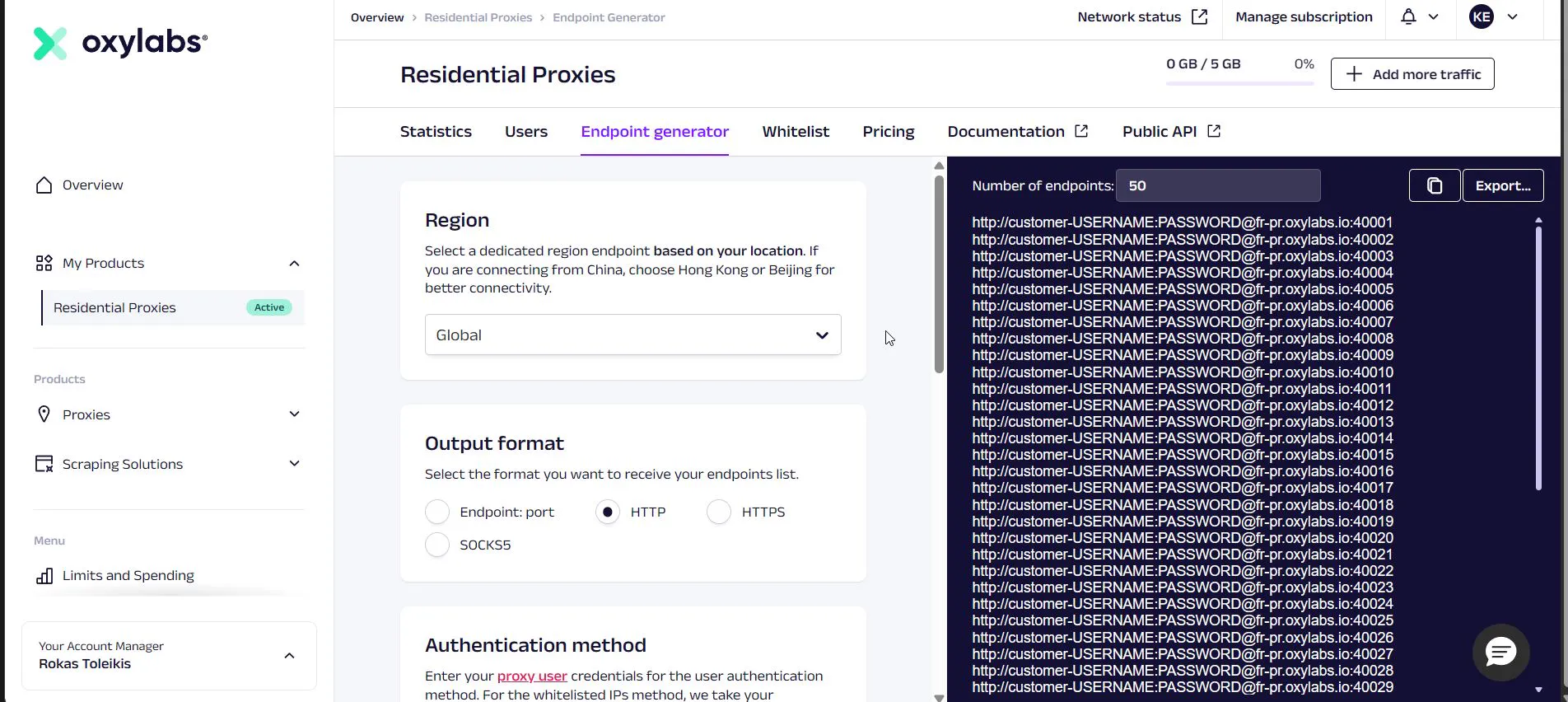
In general - if all the shortcomings related to KYC verification and the overheated security system were removed, it seems the service could be recommended as a backup option when the main provider cannot cope, but is there any sense in using an expensive and average-quality solution if there are higher-quality and cheaper competitors?
Decodo (formerly Smartproxy) - The Choice of SEO Specialists
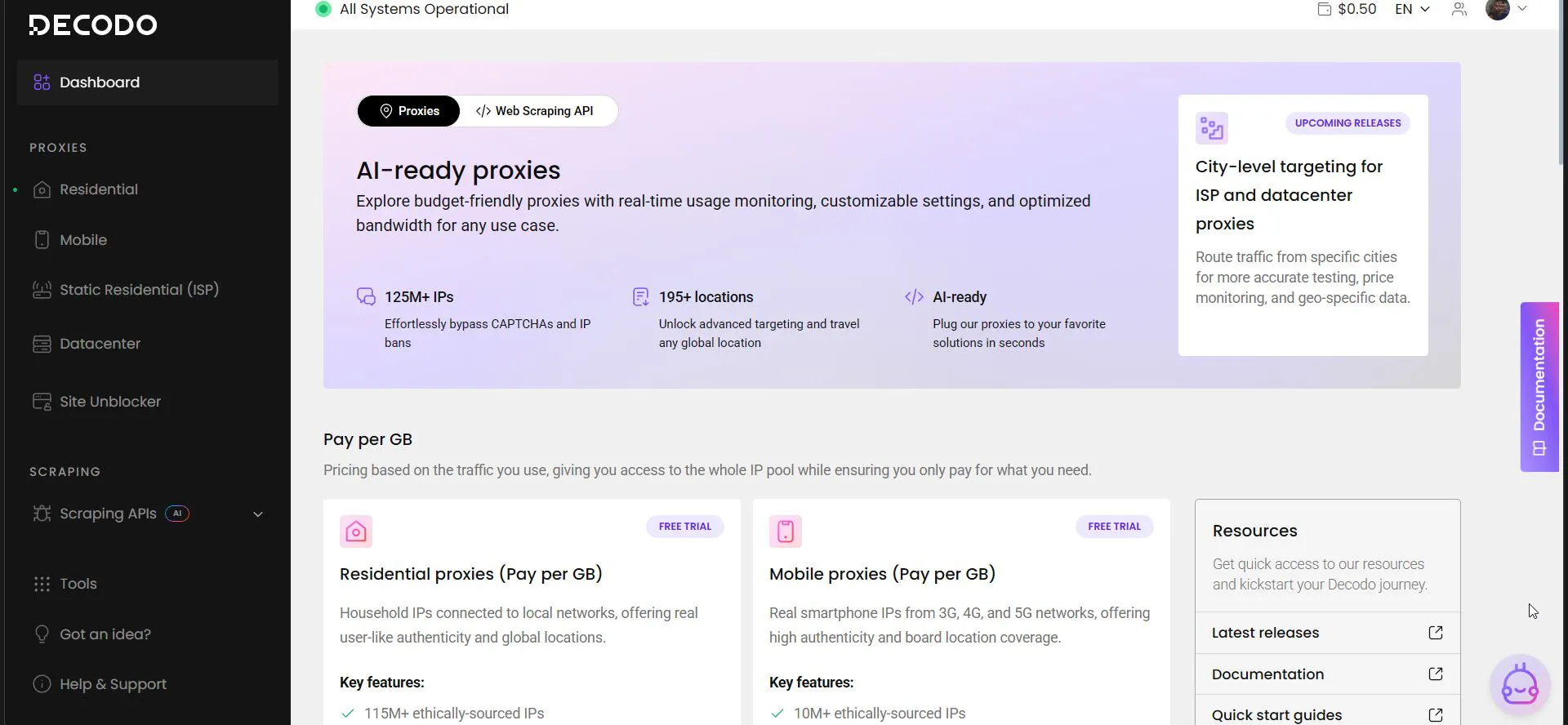
It was worth stepping further away from the “Giants,” and immediately all problems with verification, availability, and so on disappeared. Next in line is the service Decodo - it is also called the choice of SEO specialists.
The network at Decodo is more modest than the previous participants, but also impressive - over 125 million+ IPs worldwide. The focus is high-quality residential and ISP proxies. The network is less balanced than Bright Data's, but more accessible in price and simpler to work with. And according to test results, it is much better.
Testing results
Decodo showed high connection speed (on average across a pool of 50 addresses it was 12 MB/sec) - the average response time is 1.3 s. We tested the same GEO as the other providers for the purity of the experiment.
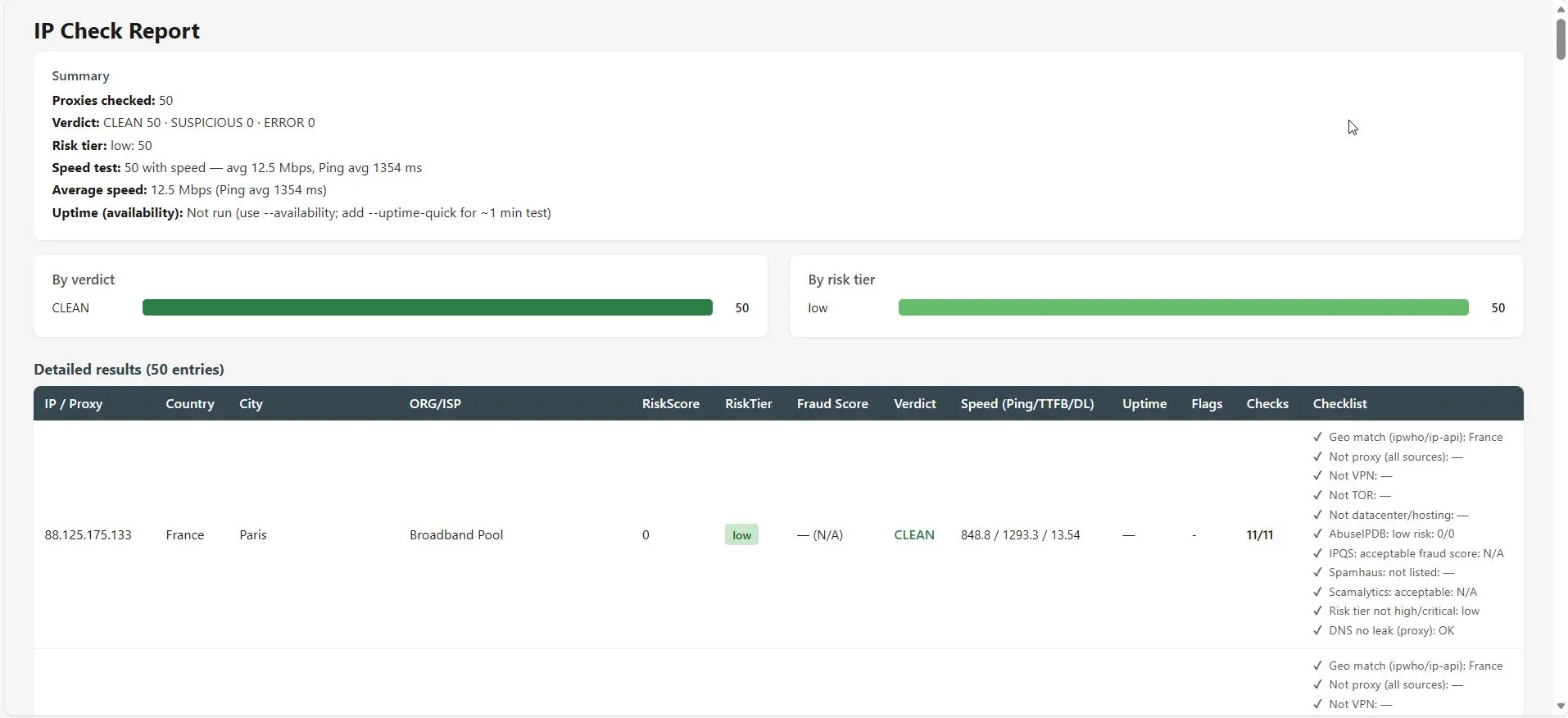
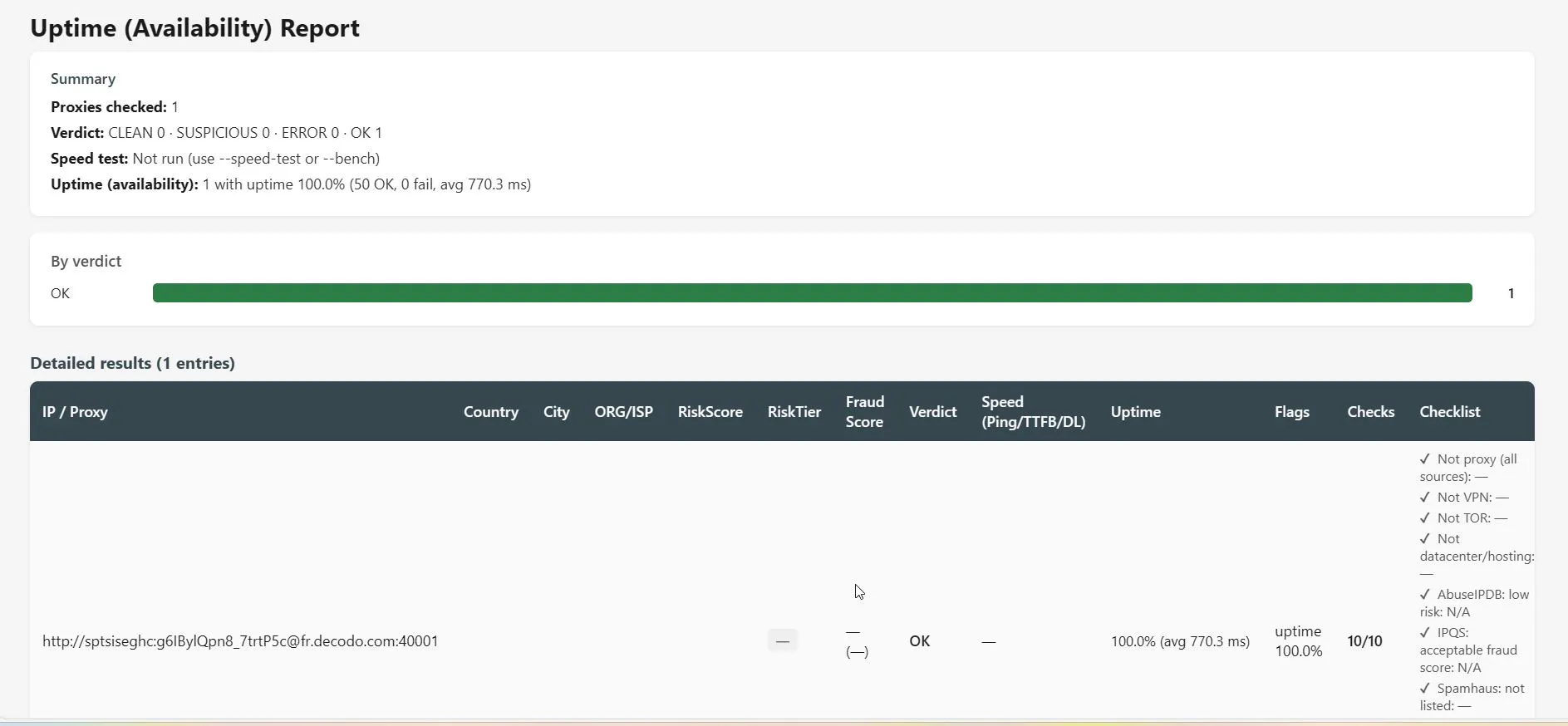
Uptime is claimed at 100%, sometimes 99% Uptime. Asian IP addresses did not fall into the general sample, but this must be mentioned - some Asian IPs had a higher IP Fraud Score, so for tasks related to Asia, it is worth checking addresses with additional tools.
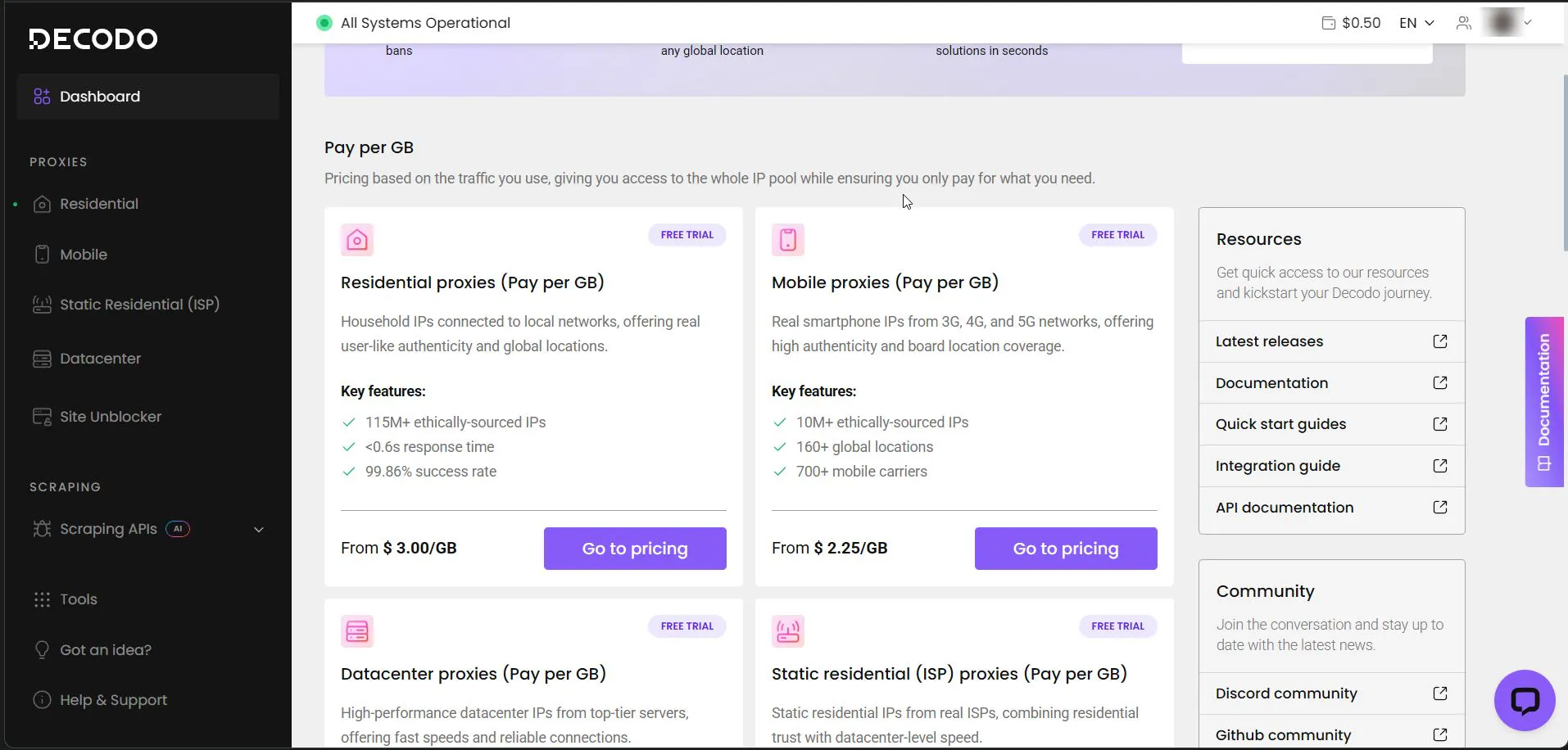
Cost of buying residential proxies via Decodo
In terms of price range, Decodo is close to Floppydata; they offer $3 per 1GB of traffic, which is significantly cheaper than Bright Data. True, such a price is available when purchasing traffic of 1000 GB and above, and on minimal packages, the price is $6. So you won't manage to save money, or you'll have to buy wholesale.
Control Panel
Decodo has a sufficiently convenient dashboard. Everything is clear, there were no surprises during setup. Everything is located in its place, there is an option for fine-tuning - Sticky sessions or Rotating residential IP, deep GEO settings for residential proxies. Everything is like standard services (we aren't taking the “giants” into account).
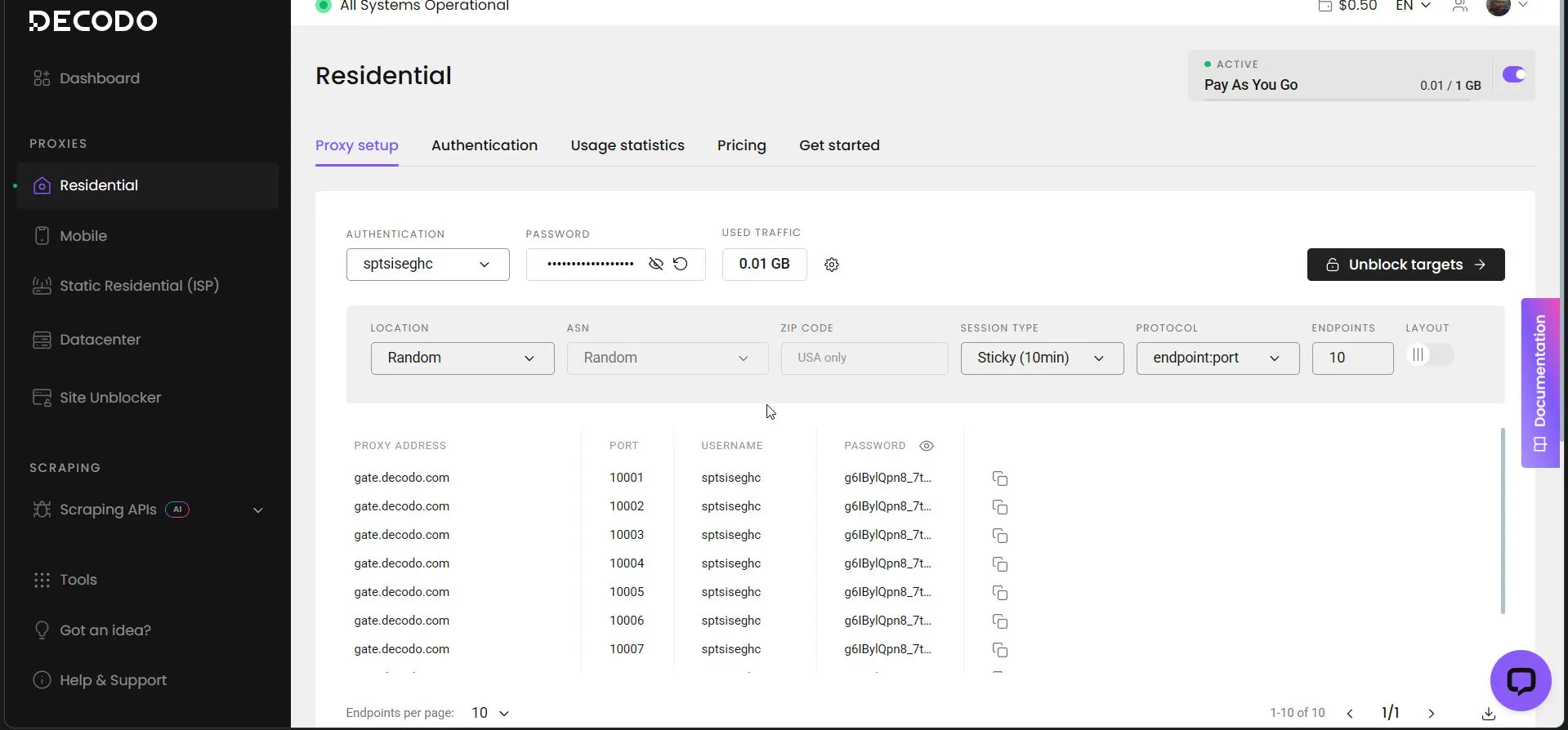
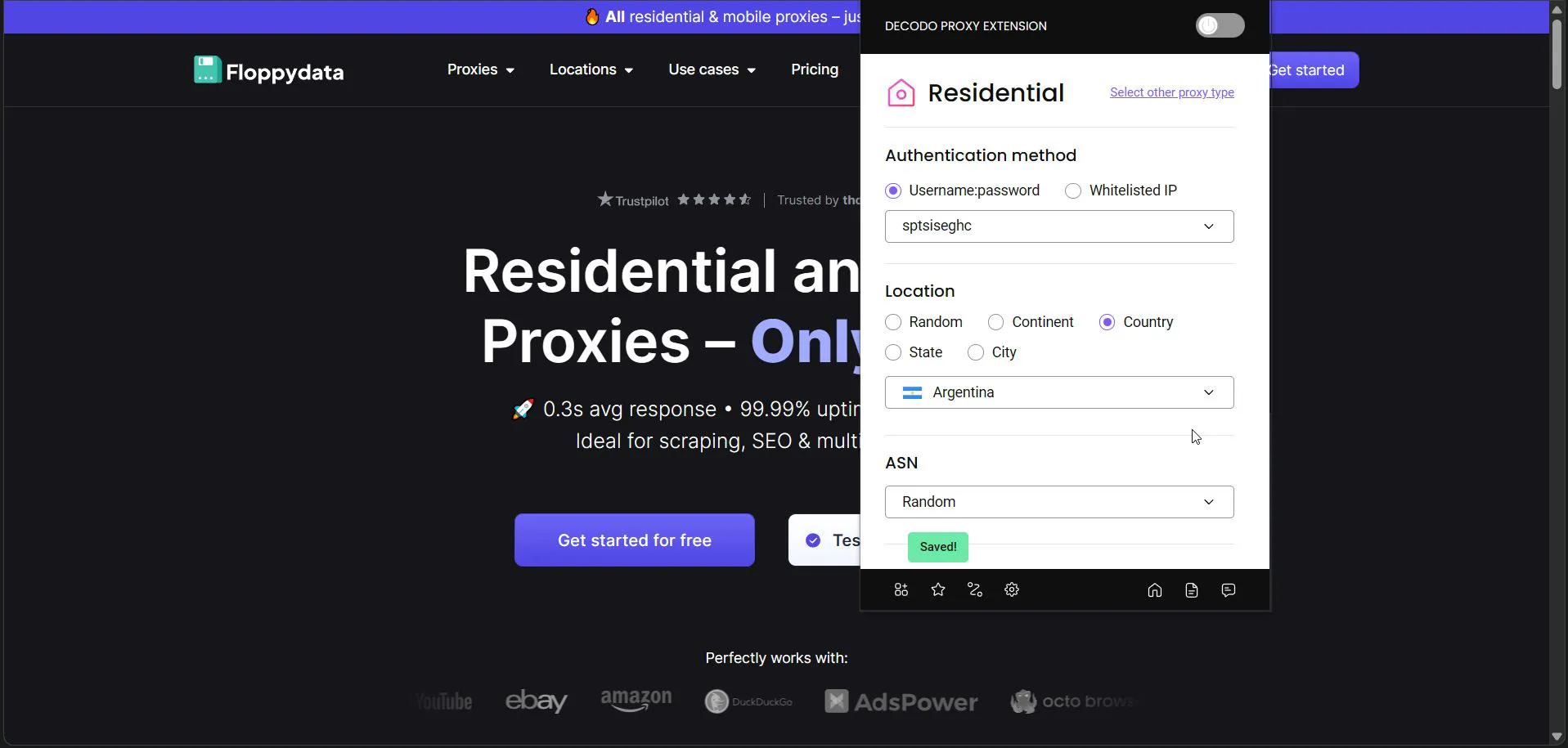
Among interesting features is the Chrome extension: it allows you to quickly change IPs without fully logging into the web cabinet. You can configure sticky sessions (Sticky) or rotation by requests.
The service is definitely worth its money, but one could also not overpay.
SOAX - Flexible Targeting by Location
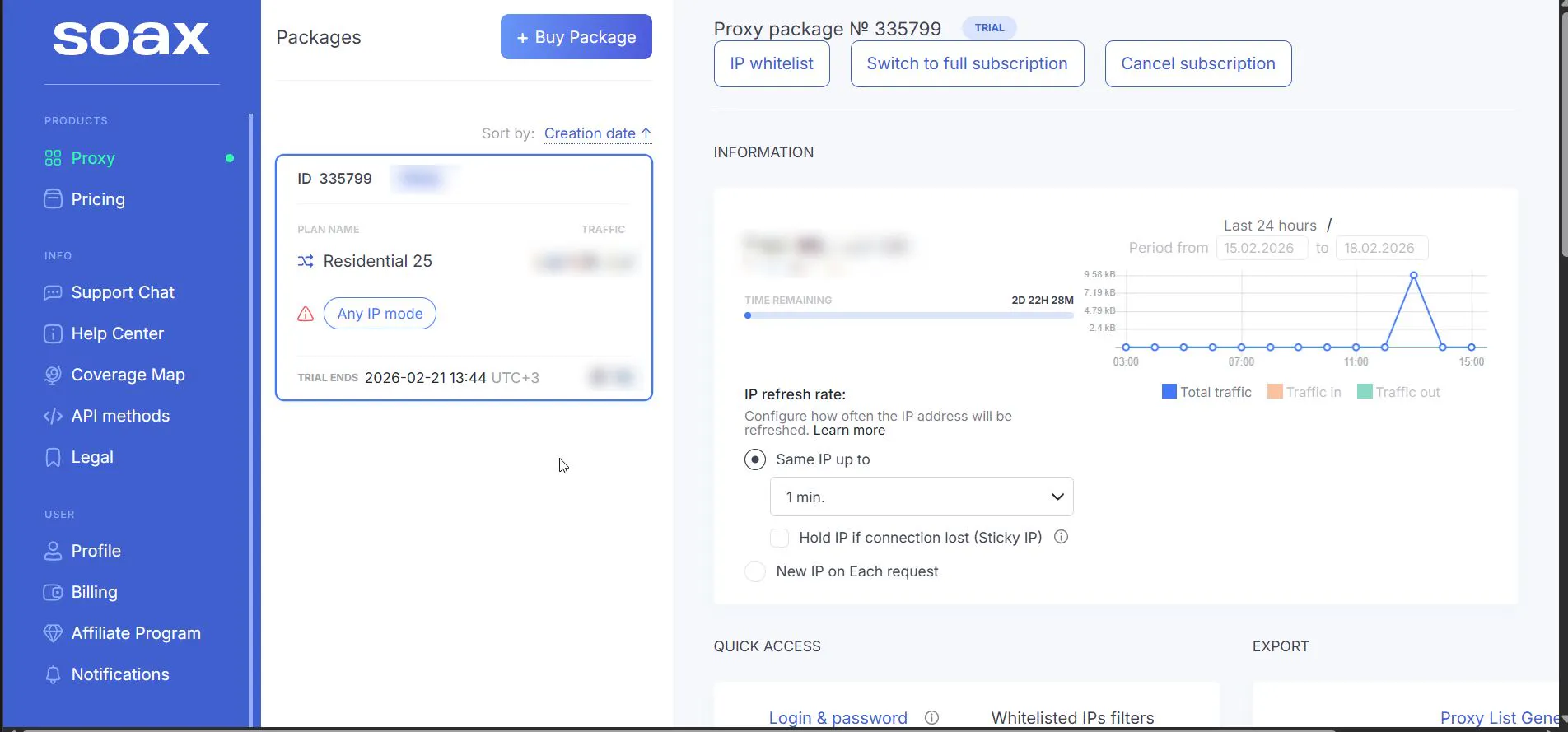
This is officially the most disgusting service of all that we had the chance to test. Starting from the admin panel and ending with the quality of the proxies.
SOAX is known for the fact that you can choose IPs not only by country/region but also by city, as well as by a specific provider. For example, when collecting data from local sources or testing mobile applications, it is important to have the ability to "freeze" sessions on a required network node.
But no one speaks about the quality of the configuration - in order to export a working proxy pool, jumping through hoops is required; initially, this kind of nonsense is exported:
login:wifi;fr;@proxy.soax.com:9044
login:wifi;fr;@proxy.soax.com:9045
login:wifi;fr;@proxy.soax.com:9046
login:wifi;fr;@proxy.soax.com:9047
login:wifi;fr;@proxy.soax.com:9048
login:wifi;fr;@proxy.soax.com:9049
For some unknown reason, the service returns the correct login but does not return the password. Actually, changing the password manually on 100+ proxies is a pleasure that is not enjoyable.
Control Panel - where to buy residential proxies?
In the web cabinet, there is a "visual node builder" (Nodes). This is a tool through which, in theory, one manages sessions, connection limits, and binding to network nodes.
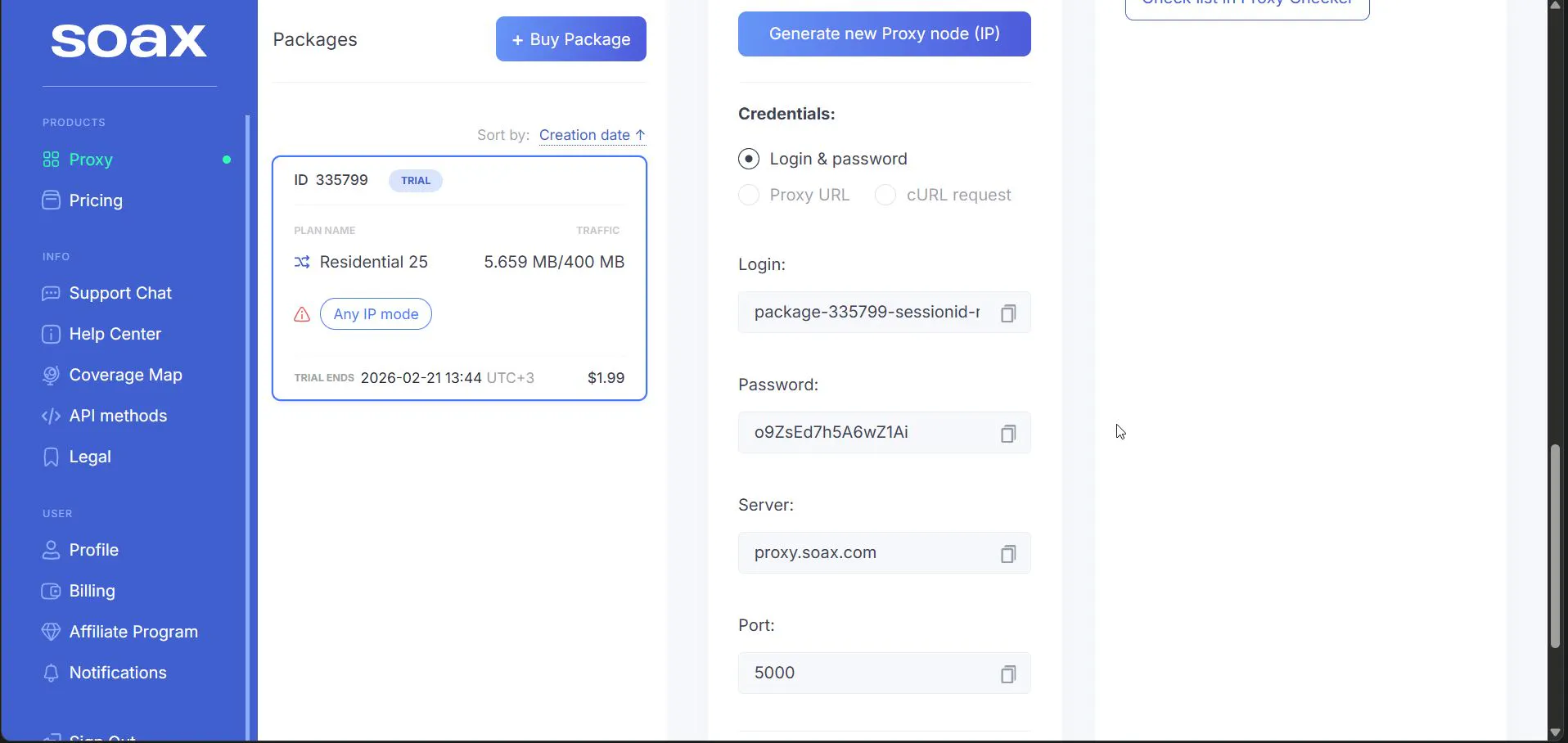
There are links to key tasks where you can configure rotation policies, duration of "sticky" sessions, and other parameters with one click.
But why all these settings if it is simply impossible to even export the pool of servers correctly?
Measurement results - or you'd better look for another place where to buy residential proxies
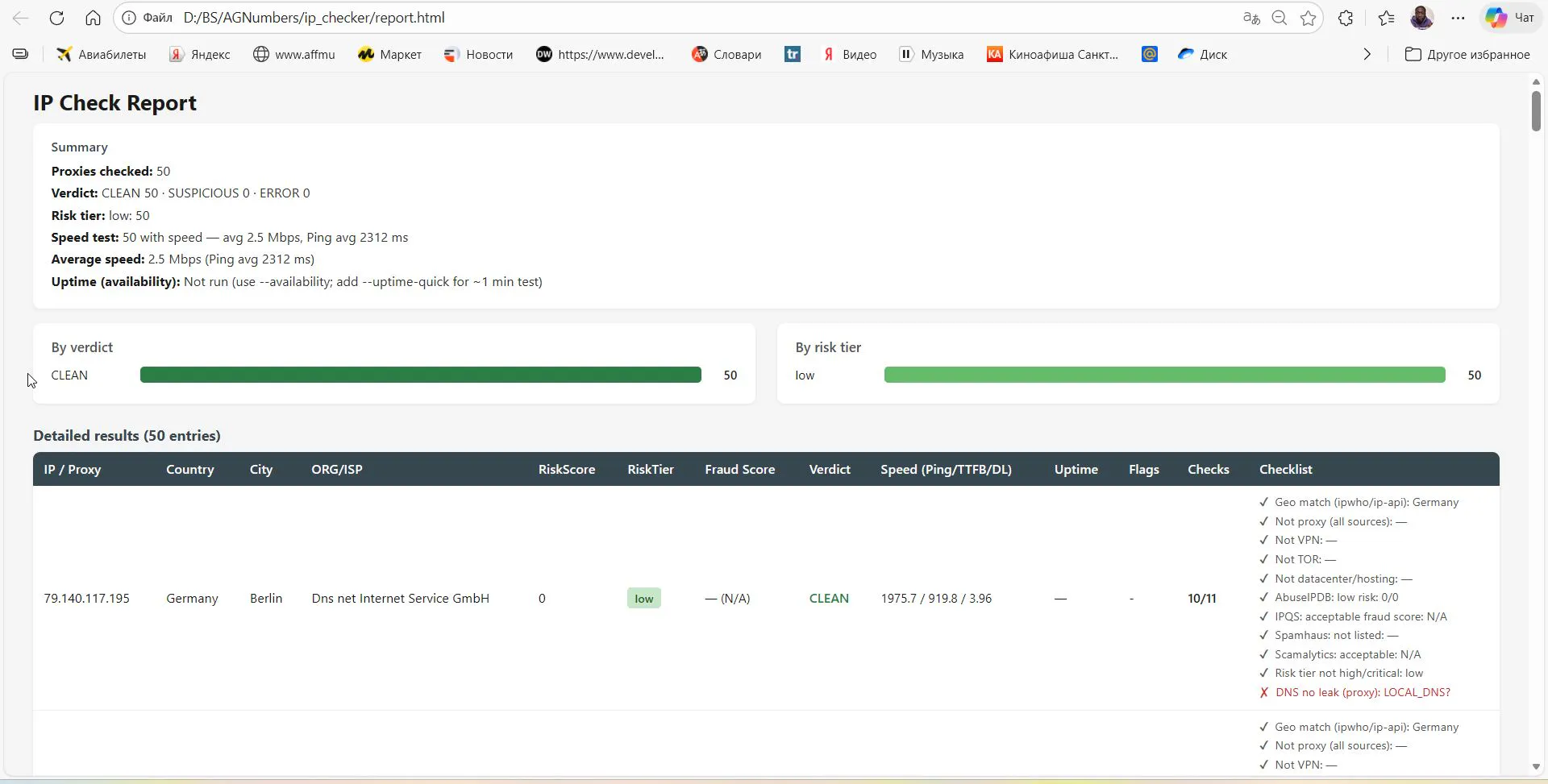
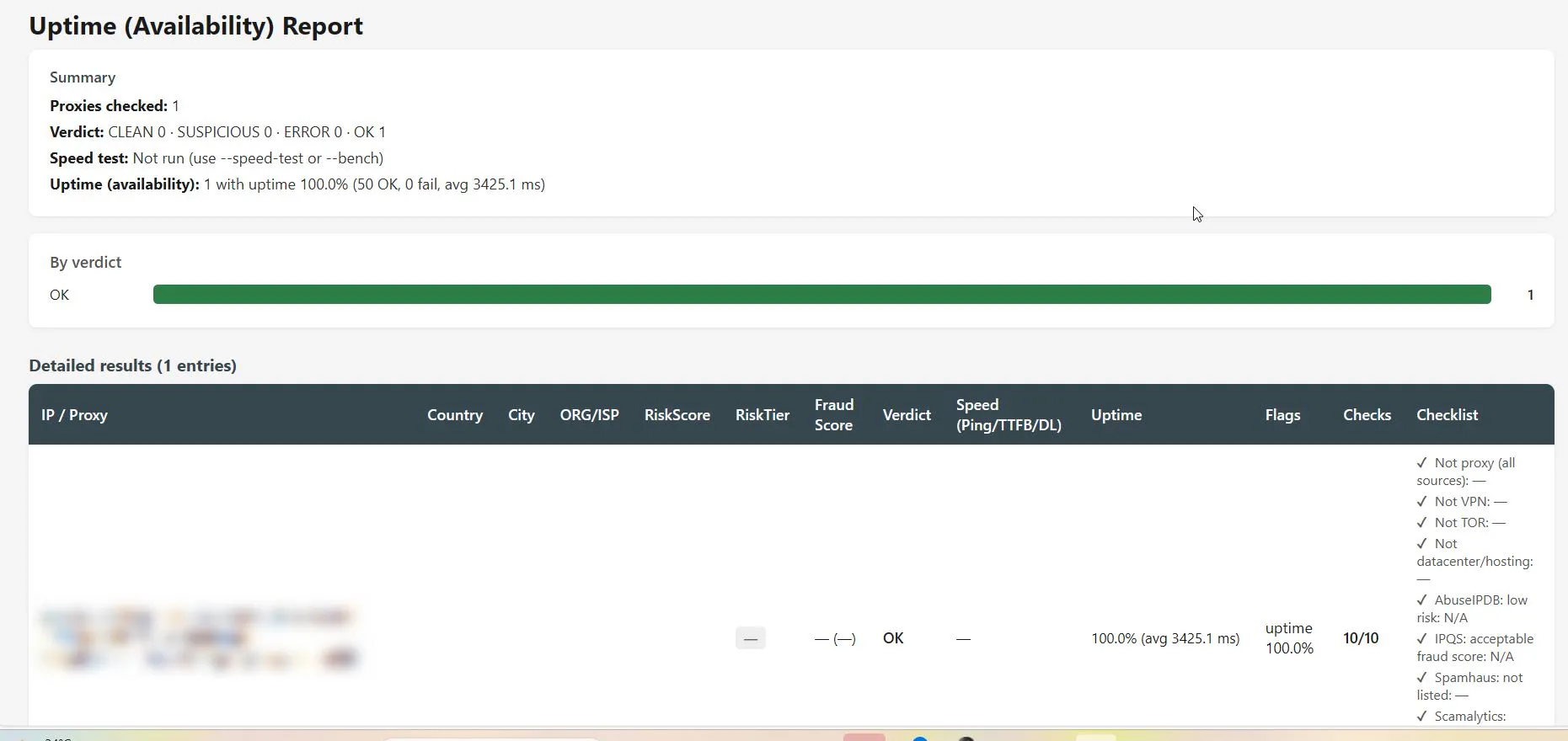
With great difficulties, we obtained a pool of 50 proxies, and for the effort expended, the result was simply worse than anywhere else. Not only did the residential proxies from SOAX have the slowest speed among competitors - 2.5 MB, and one of the highest latencies - 2.3 s, but there were also suspicions of a DNS leak.
SOAX guarantees 99.95% uptime - here there are no surprises, reliability is 100% according to our measurements.
Prices - how much do residential proxies from SOAX cost?
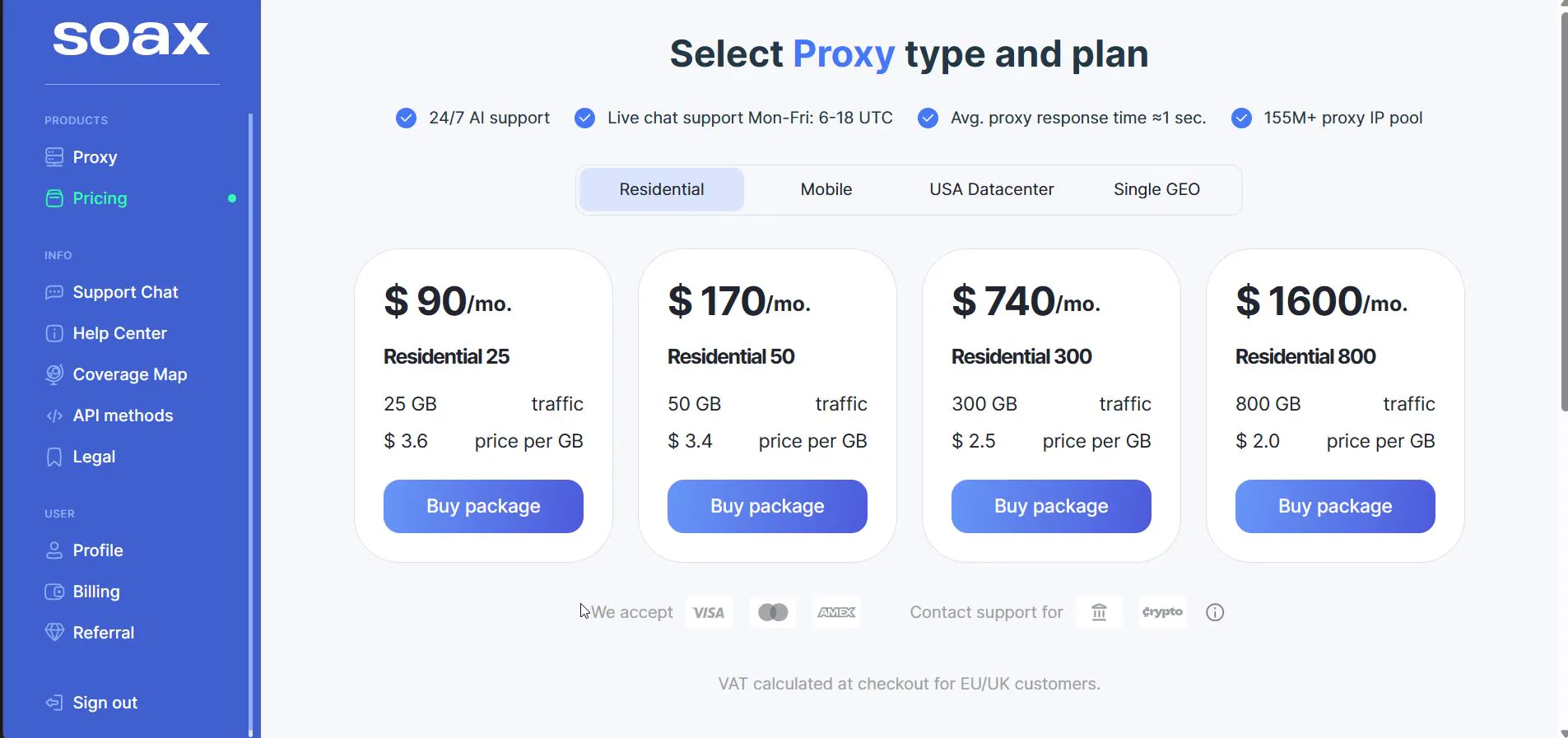
Strange as it may seem, the cost of one GB of residential proxies will cost $3.6, but you must strictly buy no less than 25 GB, and that is 90 dollars. There is a Trial for $2, and this is quite enough to understand what to expect from the service.
We will not recommend this service, as there were more problems with it than positive factors.
IPRoyal.com - Best Conditions for Small Volumes
The one who can truly compete with Floppydata in terms of convenience and simplicity of interaction with the personal account and settings is IPRoyal.
This is the second service from our top list with which there were practically no problems.
A strange observation: the smaller the pool a service has, the more user-friendly it is, and vice versa. For example, IPRoyal has about 32 million+ IPs in 195 countries. This is not small, but it is definitely less than Bright Data, which lost to it in all parameters.
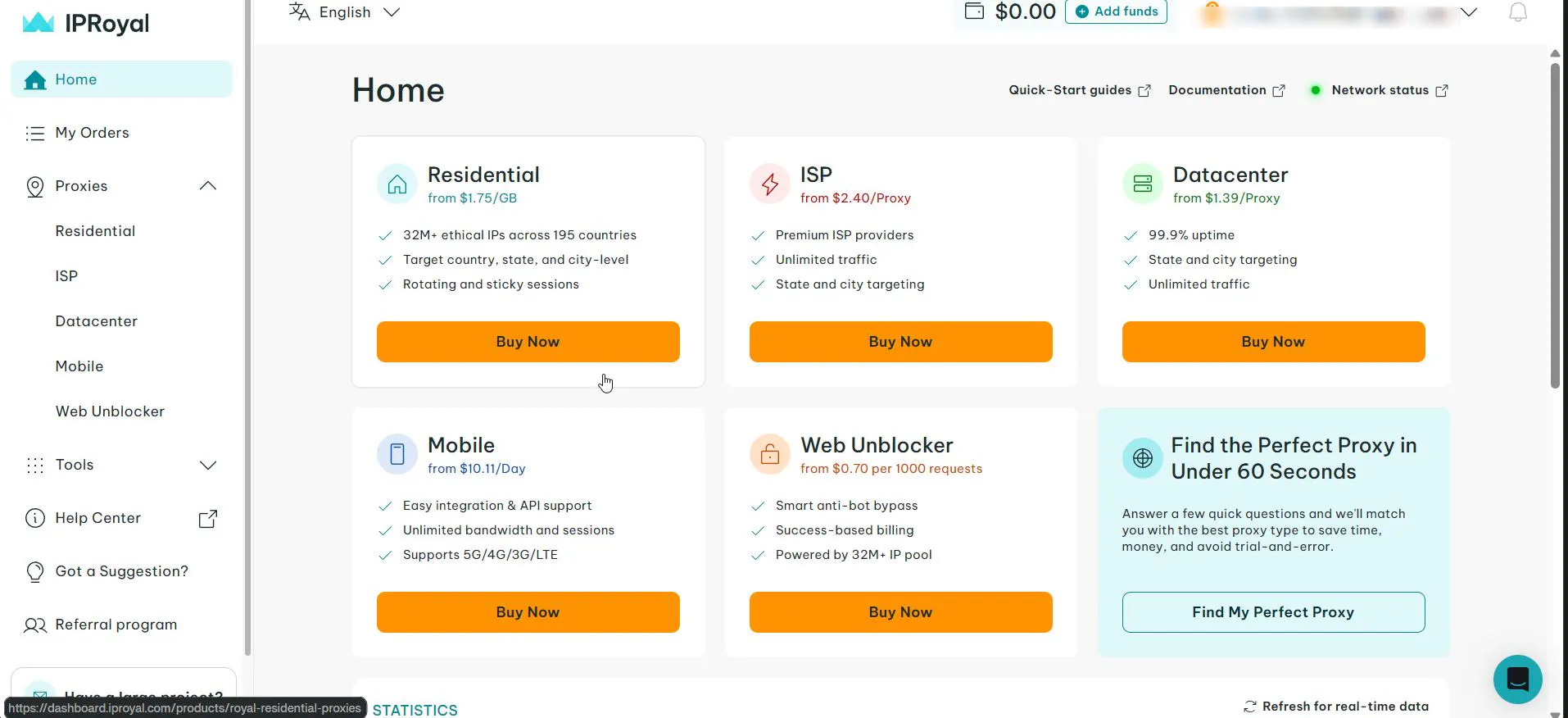
IPRoyal positions itself as a service with a "competitive price tag" and flexible billing. And so it is, the price is indeed low, from $1.75 per GB, but there is a condition - when purchasing from 10,000 GB, and a freelancer who wants to save money will never use up such a volume of traffic.
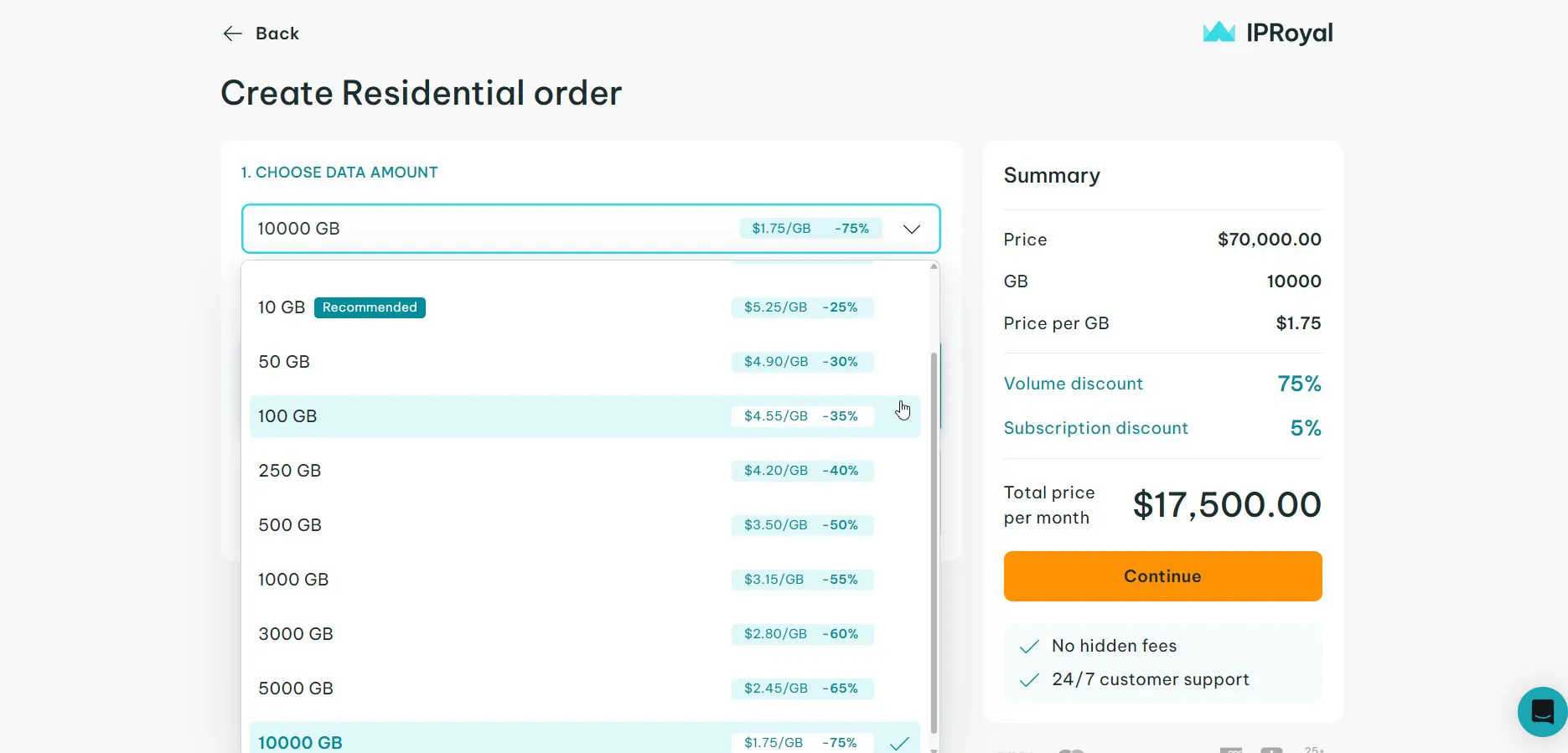
But the competitive price range (from 10 GB) is $5; this is more expensive than Floppydata and Decodo, but cheaper than the “Giants”. Therefore, freelancers and small companies also often choose it.
Test results - an excellent indicator for a residential proxy service
The residential proxy provider IPRoyal performed quite well according to the results of our tests, and if not for Uptime, it could have even claimed first place, but you can't argue against results.
So, the service showed the highest speed among all participants - 25 MB, but mediocre latency of 3.1 sec. All indicators regarding spam lists, presence of IP addresses in blacklists, and so on are in the green zone.
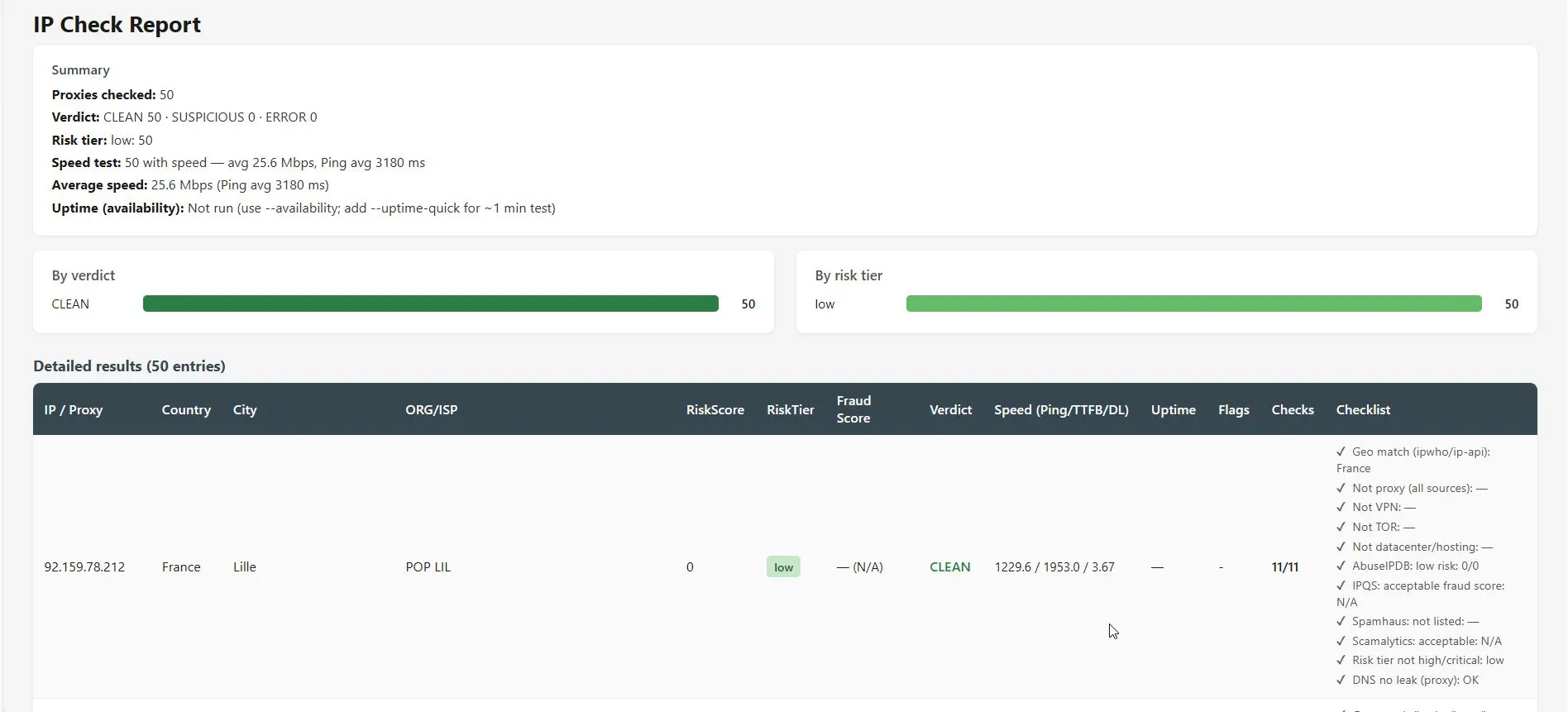
But a failure occurred on the Uptime measurements - here, unfortunately, we received an indicator of 94%; 3 requests out of 50 returned with an error. In general, these are acceptable values, but they are still lower than those of competitors.
What else IPRoyal surprised with
The main advantage of residential proxies bought at IPRoyal is that purchased traffic never expires. Bought 10 GB - use it for however long you want. This is profitable for irregular tasks or testing. Also, IPRoyal has a very simple session control system: you can set a sticky session for up to 7 days, effectively functioning as a static residential proxy for that period..
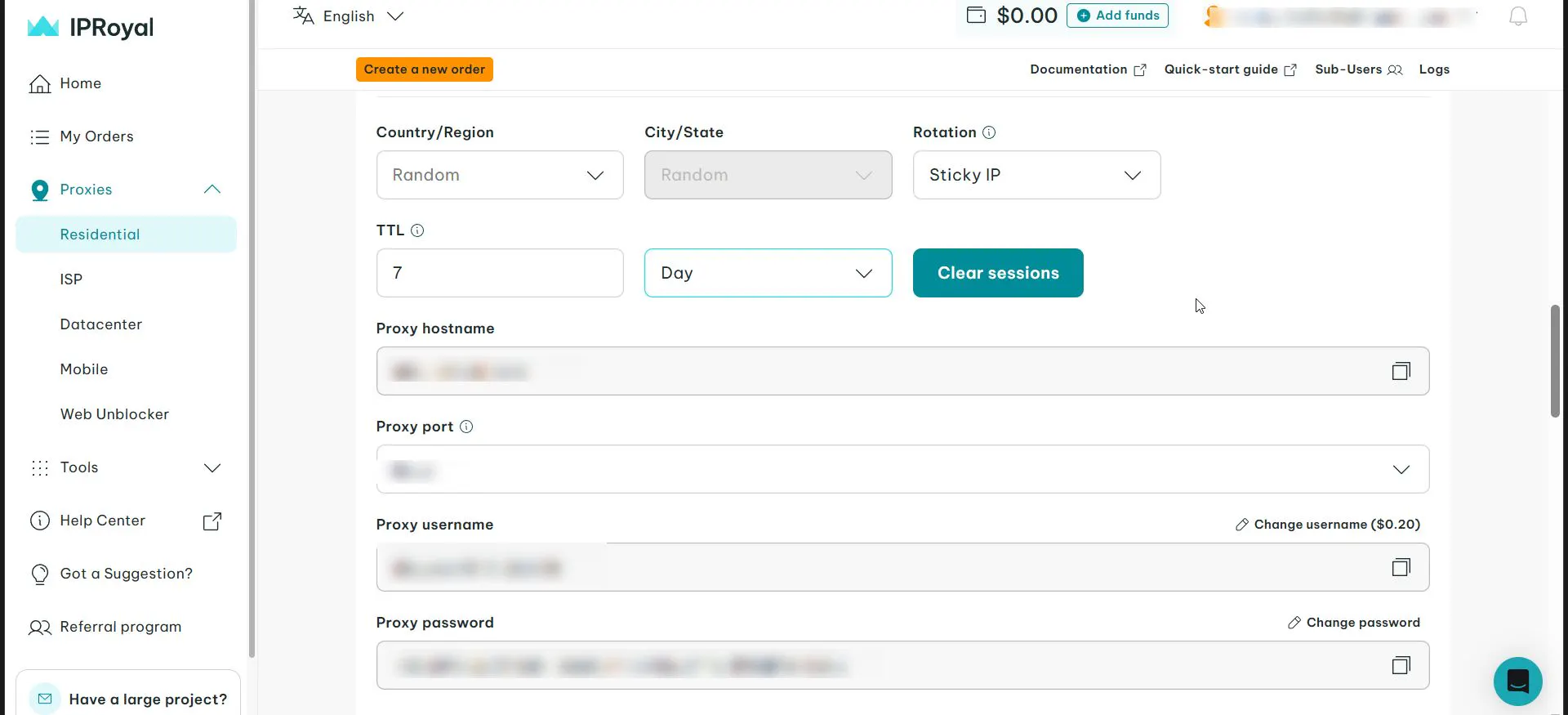
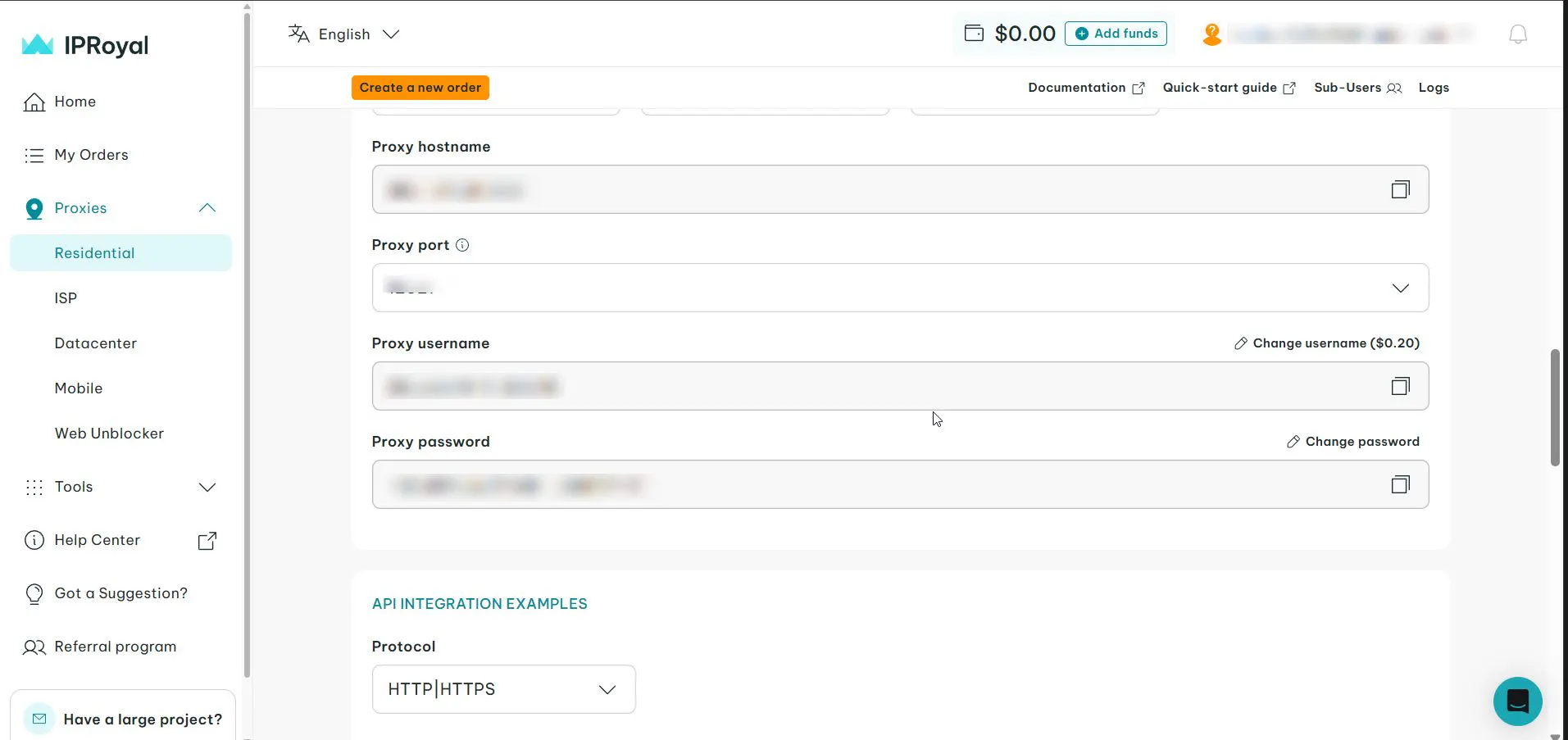
And one more interesting observation - IPRoyal skillfully monetizes trifles. They ask for 20 cents for a name change. Seems like a trifle, but they have quite a few clients. The one who came up with this probably received a nice bonus for the New Year.
Thus, we can safely recommend the service for use.
Summary Table
Provider | Latency (RTT) | Speed | Uptime (tested) | IP / DNS Reputation | Price per 1 GB | Panel Convenience | Suitable For | Final Score |
Floppydata | 1.0-1.3 sec | 8.9 MB/s | 99% | Clean IPs, no leaks | $2 (from 100 GB) | Very High | SEO, automation, scaling | Best balance of price and quality |
Bright Data | >3 sec | 7.3 MB/s | 100% | Clean IPs | $8.4 (≈$7 for large vols) | Complex, overloaded | Enterprise | Reliable, but extremely expensive |
Oxylabs | High | 12.5 MB/s | 80% | Clean IPs | Start from $40 | Enterprise-level | Large business | Infrastructure standard |
Decodo | ~1.3 sec | ~12 MB/s | 100% | Generally clean, Asia needs check | $3 (from 1000 GB), else ~$6 | Convenient | SEO specialists, agencies | Strong middle-segment |
SOAX | ~2.3 sec | ~2.5 MB/s | 100% | Suspicions of DNS leak | ~$3.6 (min. 25 GB) | Complex | Narrow GEO-targeting | Weak implementation |
IPRoyal | ~3.1 sec | ~25 MB/s | 94% | Clean IPs | $1.75 (from 10k GB), $5 - small packs | Very convenient | Freelancers, small volumes | Best for irregular tasks |
Technical Guide: How to Configure Floppydata in 2 Minutes
Since the winner of this top list is obvious, as a conclusion, here is a short guide on how to start working with the service.
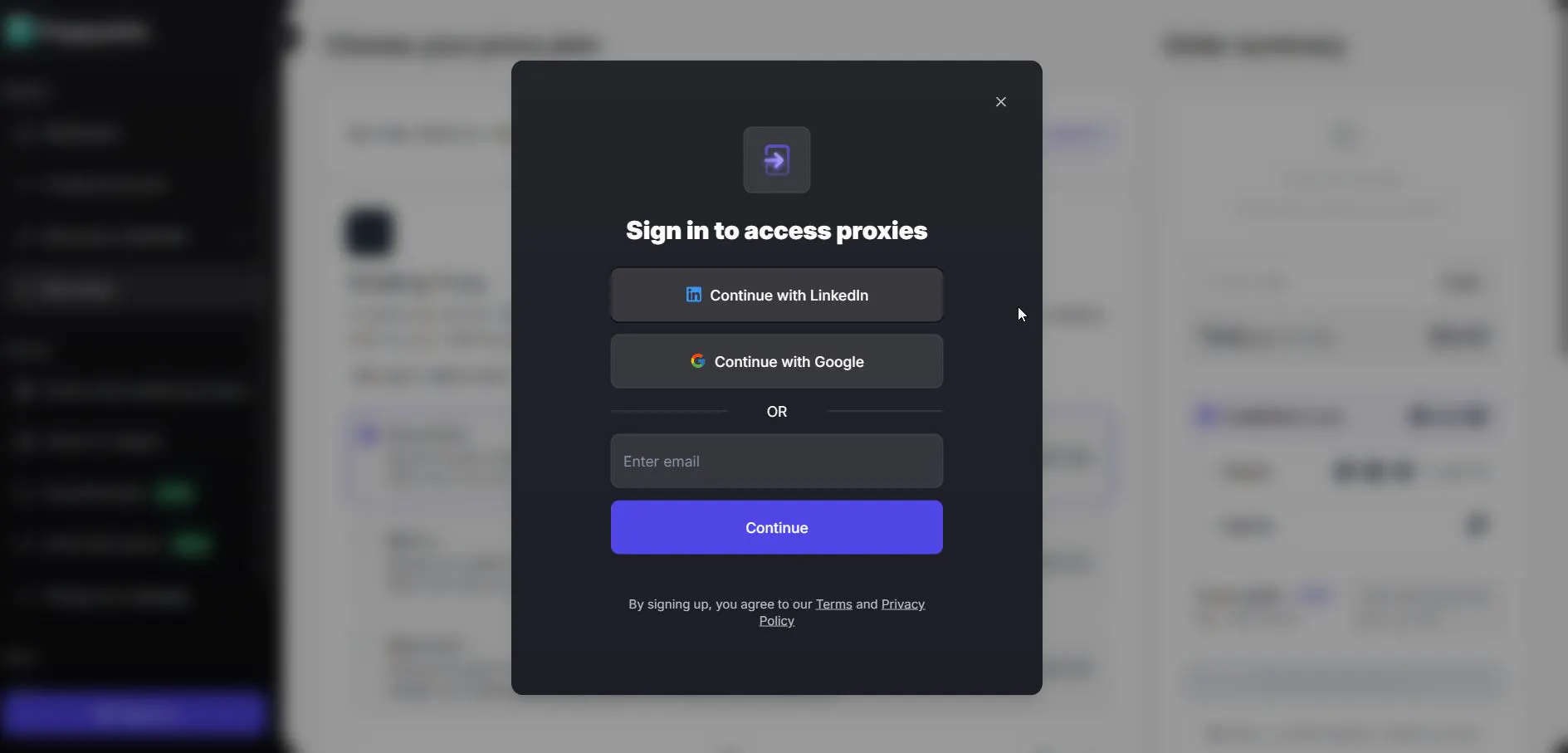
Registration. Go to the Floppydata website, create an account via email or Google, and confirm your email.
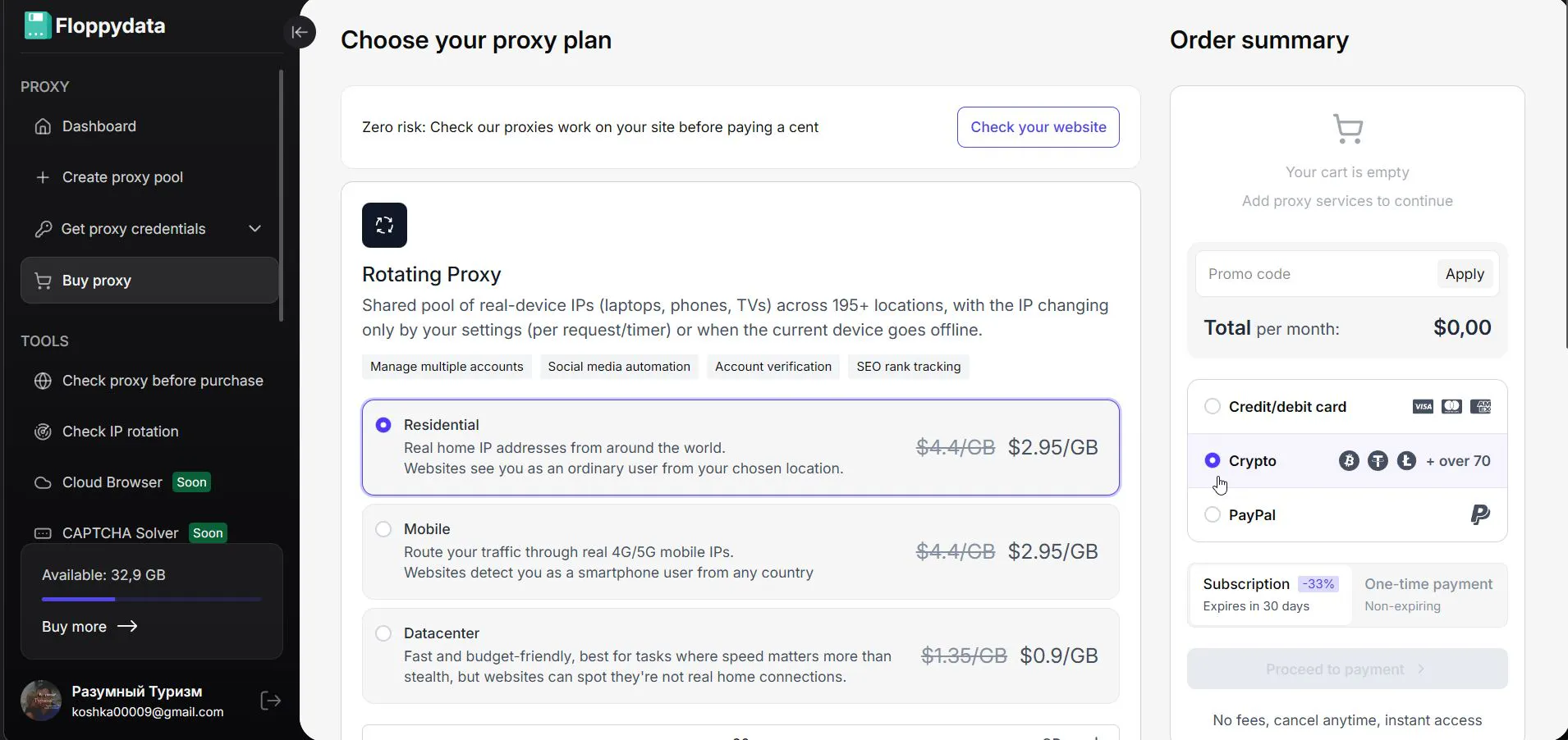
Buying proxies. Floppydata accepts more than 50 cryptocurrencies (Bitcoin, Ethereum, USDT, and others), as well as bank cards and PayPal. Choose a suitable method and pay for the volume of traffic you need. If you buy in packages, it comes out cheaper.
Generating proxies. In your personal account, click on the Create proxy pool button, specify the proxy type, select the country or region, session mode (rotation by request or Sticky), and the quantity of proxies. Press the "Create new proxy pool" button again (but this time at the bottom right, not in the sidebar) - the system will automatically generate the specified number of proxies taking into account the set filters. In the future, you can add as many proxies as needed.
Checking IPs. Before use, be sure to use the built-in Free Proxy Checker - opposite each proxy there is a check button.
That's it - your proxies are ready for use!
Conclusion
The testing conducted showed that the residential proxy market in 2026 is no longer defined exclusively by the scale of the IP pool or the loudness of the brand. The key factors have become practical stability under load, real response speed, ease of management, and economic feasibility of use.
Enterprise providers - such as Bright Data and Oxylabs - although they demonstrate high infrastructural maturity, developed APIs, and a formal level of reliability, their model is oriented towards the corporate segment with large budgets, strict verification procedures, and long-term contracts. For small and medium businesses, such an approach often turns out to be excessive. Moreover, it cannot be said that they surpass competitors in quality; rather the opposite, they yield to them.
The professional mid-level solution segment, represented by Decodo and IPRoyal, offers a more flexible balance between cost and functionality. These services are suitable for SEO tasks, automation, and regular scraping, while remaining relatively affordable. Nevertheless, differences in uptime and pricing policy can substantially affect the final economics of a project.
Separately, it is worth noting the transformation of the low-cost segment. Floppydata demonstrated that high stability (98-99%), competitive latency (about 1 second), and ease of management can be combined with a fixed and transparent price. With comparable technical results, overpaying for a brand ceases to be a rational decision.
SOAX, despite claimed capabilities for flexible GEO targeting, showed that functionality does not compensate for the complexity of configuration and mediocre network indicators.
The residential proxy market has moved from a stage of "large pools" dominance to a stage of competition in efficiency. Today, the choice is determined not by the size of the network, but by the combination of stability, transparent cost, and ease of operation.
In 2026, the optimal solution becomes the provider that ensures a predictable result without excessive restrictions and overpayment. It is this factor that forms the new standard of the industry.